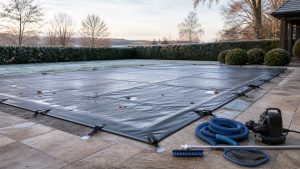
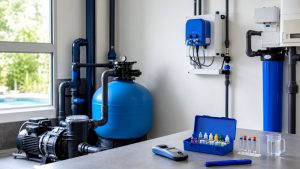
Why you should winterize both pool and hot tub at all
Winterizing isn’t a pointless formality — it’s insurance against the most expensive failure a pool can suffer: a burst pipe, a cracked skimmer, or a split pump housing. Water expands by roughly 9% when it freezes, and ice exerts enormous force on anything that contains it. One forgotten pipe under a jet, or a pump left undrained, can easily mean a repair costing anywhere from a few hundred to several thousand euros.
Proper winterizing achieves three goals at once:
- Protect the equipment from frost — draining water out of the pump, filter, pipework, and any spot where it could freeze.
- Keep the water stable over winter — so that in spring it’s merely cloudy and easy to clean, not green, smelly, and full of algae.
- Protect the structure and liner — shielding the pool from ice pressure, and in-ground tanks from cracked walls.
The difference between a well- and a poorly winterized pool only shows in spring — either you’re running clean water again within half a day, or you spend the weekend fighting green water and possibly dealing with cracked equipment.
Pool vs. hot tub: how winterizing differs
Both processes follow the same principle — get water out of anywhere it could freeze — but they differ in execution and strategy.
| Parameter | Pool | Hot tub (spa) |
|---|---|---|
| Basic approach | Usually full “dry” winterizing (water drained from the equipment, water level lowered) | Either full draining, or running all winter with heat maintained |
| Water in the tank | Stays in place (lowered below the jets/skimmer) | Usually drained completely when winterized |
| Critical spots | Skimmer, jets, pipework, filter, pump | Jets, pumps, heater, air intake, all the tubing |
| Extra decision | — | Winterize, or keep heating? Depends on running costs and how often you use it |
With a hot tub, it’s crucial to know that its plumbing contains dozens of metres of narrow tubing that can’t be reliably drained by gravity alone — the residual water has to be blown out. That’s why winterizing a hot tub can’t be “shortcut” the way a pool sometimes can. If you use your hot tub in winter too, consider keeping it running instead of winterizing it — as our breakdown of monthly hot tub running costs shows, the difference may not be as large as you’d expect, and a hot tub steaming away in the snow is an experience in itself.
When to winterize: water temperature and timing
The most common mistake is winterizing too early — algae thrive in warm water, and it will “bloom” over the winter. Follow two rules:
- Water temperature has dropped consistently below 15°C. Below this threshold, algae and bacteria growth essentially stops, so the water stays stable. Don’t winterize on warm water just because “the holidays are over.”
- Time window: mid-September to end of October. In Czechia, the second half of October is typically ideal for most regions. But don’t put it off until the first frosts hit — you need time to drain the equipment before it freezes.
A practical compromise: watch the forecast and winterize in the window when the water is below 15°C but overnight frost isn’t yet a risk. We cover timing and temperature measurement in detail in a dedicated article, When to winterize a pool and hot tub by water temperature.
The whole process, step by step
The following procedure applies to a classic in-ground or built-in pool with a skimmer and sand filtration. Above-ground and inflatable pools, and hot tubs, have their own specifics (see the links below), but the underlying logic stays the same.
- Clean the pool and the water. Vacuum the floor, remove leaves from the surface and the skimmer, and brush the walls. Clean water is easier to put “to sleep,” and you’ll save yourself a lot of work in spring.
- Balance the water chemistry. Set pH to 7.0–7.4 and carry out a thorough disinfection (shock chlorination). Balanced water going into winter is the foundation the whole winterizing process rests on.
- Let the filter run the water clean and do one final backwash of the sand filter. Then leave the filter drained for the winter.
- Add a winterizing agent (algaecide). Dose a winter algaecide according to the pool volume and let it circulate for a few hours so it disperses evenly. This product prevents algae growth even when the water isn’t circulating.
- Lower the water level below the jets and skimmer. The water needs to drop enough that no water remains in the jets or skimmer — that’s where ice most often cracks things. On covered systems, the level also needs to sit correctly under the cover.
- Drain the equipment. Empty the pump, filter, heat pump exchanger, and all the pipework. Open the drain plugs and blow out any residual water in the pipes with a compressor. This is the single most important step — wet equipment means a real risk of cracking.
- Plug the jets and skimmer. Fit winter plugs into the jets, and a winterizing float (a “gizmo” or hose) into the skimmer to absorb ice pressure.
- Add winterizing floats. Distribute floats (compensators) across the surface; they absorb the expansion of freezing water and protect the pool walls.
- Cover the pool. Fit a winter cover or close the enclosure. Covered pools clearly collect far less debris over winter.
We’ll walk through each of these steps in more detail in follow-up articles. Here you’ve got the overall map — now let’s look at what you’ll actually need.
What you’ll need
The shopping list breaks down into four groups. Most items are reusable, so it’s a one-off investment that will serve you for several seasons.
Chemicals
- pH adjuster (pH minus / pH plus) to bring the level to 7.0–7.4.
- Disinfectant for shock chlorination before winterizing.
- Winterizing agent / winter algaecide against algae during the winter.
- Tester or photometer to check pH and chlorine.
Winterizing floats and compensators
- Floating compensators for the surface, which absorb ice pressure and protect the walls.
- Large pools need several, spread across the whole surface.
Gizmo and plugs
- Skimmer gizmo (winterizing hose/float) — absorbs the expansion of ice in the skimmer, otherwise the most vulnerable spot in the whole system.
- Winter plugs for the jets and blanking caps for the return fittings.
- Compressor to blow out the pipework (can also be rented).
Covering
- Winter cover or a working pool enclosure that keeps debris out over the winter.
- Fixing elements (tensioning rope, clips) so the cover doesn’t blow away.
Approximate costs
Prices vary depending on pool size and whether you do the work yourself or hire a company. Treat the figures below as a rough guide for a typical family pool. Prices below are the Czech company’s own service pricing (Czech market, for reference), with approximate EUR equivalents added.
| Item | Approximate price |
|---|---|
| Winter chemicals (algaecide, pH, disinfectant) per season | 500–1,500 Kč (approx. €20–60) |
| Winterizing floats and compensators (one-off) | 500–2,000 Kč (approx. €20–80) |
| Gizmo + jet plugs (one-off) | 300–1,000 Kč (approx. €12–40) |
| Winter cover (one-off, depending on size) | 1,500–6,000 Kč (approx. €60–240) |
| DIY winterizing (consumable chemicals only) | from approx. 500 Kč / year (approx. €20 / year) |
| Professional winterizing (labor incl. draining the equipment) | 2,500–6,000 Kč (approx. €100–240) |
If you hire a company, this is usually part of a broader end-of-season pool service package — it’s worth booking an equipment check at the same time.
Detailed guides for your situation
This page is a hub. Depending on what you’re dealing with, continue to the specific guide:
- When to winterize a pool and hot tub by water temperature — how to measure temperature, why the 15°C threshold matters, and how to hit the right window without winterizing too early or too late.
- Winterizing an above-ground or inflatable pool — the specifics of framed and assembled pools, when to drain the water fully and when not to, and how to protect the structure.
- Hot tub in winter: run all year, or winterize — blowing out the tubing, protecting pumps and heaters, and the decision between winterizing and keeping it running.
- The most common winterizing mistakes — what to avoid so you’re not in for an unpleasant surprise come spring.
When to call in a company
Most owners can manage winterizing themselves, but in some situations it’s wiser to call a professional:
- You don’t have a compressor or don’t know how to blow out the pipework. Residual water in the pipes is the most common cause of cracks — if you’re not sure you got it all out, you’re risking an expensive repair.
- You have a heat pump or heat exchanger. Draining them has its own rules; get it wrong and you end up with a cracked exchanger. If you’re also looking into sizing and operation, read how a pool heat pump works.
- Your pool is large or has complex technology. Counter-current systems, water features, multiple circuits — every extra point is a potential risk.
- It’s your first time winterizing. It’s worth having a professional show you the process the first season — you’ll be able to handle it yourself next time.
Don’t want to winterize it yourself? Hire a service company — submit a request and compare quotes from vetted companies in your area. You’ll save time and avoid the risk of an expensive spring repair.
Frequently asked questions (FAQ)
When is the best time to winterize a pool?
Once the water temperature has dropped consistently below 15°C, but before sustained overnight frost sets in. In Czechia, that typically works out to the second half of October for most regions. The winterizing window runs roughly from mid-September to the end of October.
Why exactly a water temperature below 15°C?
Below 15°C, algae and bacteria growth essentially stops. If you winterize while the water is still warmer, algae keep growing and the water will bloom green over the winter. Go by water temperature, not air temperature or the calendar.
Do I have to drain the pool completely?
Not for an in-ground concrete or fiberglass pool — the water stays in the tank, you just lower the level below the jets and skimmer. Fully draining is only done in exceptional cases (e.g. during a renovation), and it risks the shell shifting or being damaged. For above-ground pools, the decision depends on the construction type — more in the dedicated guide.
How far should I lower the water level?
Below the level of the jets and the bottom edge of the skimmer, so no water remains in them that could freeze and crack them. The exact height depends on where the jets sit — as a general rule, expect to lower the level by 10–20 cm below the lowest jet.
What pH should the water have before winterizing?
Set the pH to 7.0–7.4. In this range the water is most stable, the chemicals work best, and there’s no risk of corrosion or scaling problems over the winter. Also carry out a shock chlorination before winterizing.
What’s a winterizing agent (algaecide) for?
Winter algaecide prevents algae growth even with low water activity and no filter circulation. It’s dosed according to the pool volume and given a few hours to disperse. Without it, the water turns green much more easily over the winter.
What is a gizmo and why do I need one?
A gizmo is a winterizing float or hose that you place in the skimmer. It absorbs the expansion of freezing water, protecting the skimmer — otherwise one of the most vulnerable points in the whole system — from cracking. Compensators on the pool surface play a similar role.
Do I need to check on the pool over winter?
Yes, but only occasionally. Check that the cover or enclosure is holding, that too much water or snow isn’t building up on it, and that the level hasn’t dropped below the protective floats. During thaws, it’s a good idea to pump excess water off the cover.
Is it better to winterize a hot tub, or leave it heating?
It depends on how often you use it. If you want to relax in it during winter too, it’s usually more sensible to keep it running with heat maintained — winterizing and spring start-up also cost something, and every drain-and-refill wastes water unnecessarily. If you won’t use it over winter, winterize it thoroughly, including blowing out the tubing. A breakdown of monthly hot tub running costs will help you decide.
What if I winterized properly but the water is green in spring?
Green water in spring usually isn’t a disaster — typically you just need to adjust the pH, run a shock chlorination, start the filter, and possibly add a flocculant. You’ll find the full step-by-step process in our guide on what to do about green pool water.
Next step
Planning a similar pool, hot tub or wellness project?
Move from inspiration to the company directory, a clear request or a regular editorial selection.