In Czechia, pool winterizing is traditionally planned for “the end of September” or “after the last warm spell of autumn.” But the weather varies from year to year, and the one figure that actually determines the right timing is the water temperature. Winterize too early and the water stagnates under the cover for no good reason, giving you a nasty surprise in spring. Winterize too late and the first hard frost can damage the filter system, pipework, and skimmer. This guide shows how to find the right window using a thermometer, not a date.
Why water temperature decides, not the date on the calendar
The same date brings different weather every year. One October might stay warm, with water above 18°C into mid-month; another might bring overnight frost as early as late September. A garden’s own microclimate makes a difference too: a pool on a sunny south-facing slope in a low-lying area holds its heat far longer than one in a shaded hollow in a highland region. A calendar ignores these differences; a thermometer doesn’t.
Winterizing is also a one-off action that’s hard to reverse. Once you’ve lowered the water level, blown out the pipework, and added the winterizing agent, you’re not going to fire the filter back up just because of one warm week. That’s exactly why it pays to get the timing right the first time — and temperature is what determines it.
The key threshold: water consistently below 15°C
Algae and most bacteria multiply more slowly the colder the water gets. Once the temperature drops consistently below 15°C, their growth essentially stops. That’s the biological reason this particular threshold marks the start of the winterizing window: cold water doesn’t “go off,” and stays clean even without daily filtration and chlorination.
The key word is “consistently.” One cold night isn’t enough. The water needs to stay below 15°C during the day too, for several days in a row, so you can be confident that warm weather won’t return and push the reading back up. In practice, that means checking the temperature each morning, when it’s at its lowest, for roughly three to five days.
You can perfectly well winterize somewhat colder water too, say around 10°C. The only thing that matters is not overshooting the lower limit: don’t wait until the water starts icing at the surface before you winterize. The ideal window for action is therefore roughly 8 to 12°C — the water is already biologically “dormant,” but still well clear of freezing.
When this typically happens in Czechia
The thermometer always sets the exact date, but a rough overview helps with planning. Altitude and current weather patterns are the main factors:
| Location / altitude | When water typically drops below 15°C | Typical winterizing window |
|---|---|---|
| Lowlands up to 300 m (e.g. the Elbe and Ohře river basins, southern Moravia) | mid- to late October | third week of October to early November |
| Highlands and foothills, 400–600 m | early to mid-October | first half of October |
| Mountain areas above 700 m | late September to early October | turn of September/October |
In Czechia, in-ground pools in the lowlands are therefore often still in use as late as November, while an above-ground pool in the foothills may already be ready for winterizing at the turn of September and October. The gap between a warm lowland and a cold foothill area can easily exceed two to three weeks — a useful illustration of how much local climate matters, wherever you happen to be.
In-ground vs. above-ground pool: why the timing differs
The type of pool has a major effect on how fast the water cools. An in-ground pool is surrounded by soil, which acts as thermal insulation and a heat reservoir. Its water drops below 15°C more slowly and stays warmer for longer — so you can stretch the season a bit further into autumn.
Above-ground pools have walls exposed to air on all sides and a smaller water volume, so they react to cooling much faster. They chill sooner, but are also more sensitive to frost: a thin liner and plastic frame ice up more easily than a solid in-ground shell. For above-ground pools, watch the temperature more closely in autumn, and don’t leave winterizing until the last minute.
Risks of bad timing
Winterizing too early
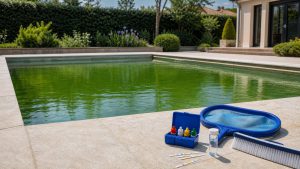
If you close up the pool while the water is still warmer than 15°C, it will start stagnating under the cover. Without filtration, and with residual warmth still lingering, algae can easily take hold and the water turns green or cloudy by spring. Early winterizing also needlessly shortens your swimming season — you lose warm September and October days for no benefit. Longer stagnation also means a harder spring start-up and more chemicals needed to clean up.
Winterizing too late
The opposite extreme is more dangerous. Water freezes at 0°C, and ice expands as it forms — if any is left in the pipework, filter, pump, or skimmer, it can split them open. Burst pipes, a cracked sand-filter head, or a ruined pump are among the most expensive types of damage a pool can suffer. So the rule is: finish winterizing before the first hard frost arrives, not after. Watch the forecast, and treat several cold nights in a row as your cue to act.
How to track water temperature properly
To make the 15°C threshold actually work for you, measure correctly and consistently:
- Measure in the morning. The water is at its coldest after a cold night and warms up during the day from the sun. A morning reading best shows how far the water has actually dropped.
- Measure at depth, not just at the surface. The surface can be either cooler or warmer, depending on the sun. A reading roughly 30 cm below the surface is more representative.
- Track the trend, not a single reading. Log the temperature for several days in a row. What matters is that it holds stably below 15°C, not a one-off dip.
- A reliable thermometer. A floating pool thermometer or a digital sensor in the equipment is enough. With smart controllers, water temperature is often shown directly in the app.
- Keep an eye on the frost forecast. Falling water temperature plus a forecast of overnight frost is a clear sign the winterizing window is closing.
Don’t drop maintenance entirely during this transition period — until you winterize, regular filtration and chlorination following a weekly pool maintenance schedule keeps the water clean.
Hot tubs: either run all year, or drain completely
The same logic that applies to pools doesn’t apply to hot tubs — a small water volume and sensitive equipment allow for only two solutions, with nothing in between:
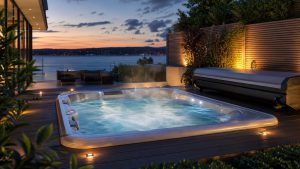
- Year-round operation. You leave the hot tub running through winter, with the water continuously heated and circulating. A heated tub in the middle of a freezing day is a real comfort, but expect higher energy use — we break down what it costs to run in how much a hot tub costs to run per month.
- Full draining before the first frost. If you won’t use the hot tub over winter, you must drain it completely — the tank, pipework, pump, and blower. Residual water left in the pipes will freeze over winter and damage expensive equipment.
What you must never do: leave water sitting in a hot tub without heating. A powered-off hot tub with water still in it is the worst option of all — the water spoils quickly, and the pipework cracks at the first frost. Either it’s heating and circulating, or it’s completely empty. Nothing in between.
Frequently asked questions (FAQ)
At what water temperature should a pool be winterized?
Once the water temperature drops consistently below 15°C, including during the day and for several days in a row. Below this temperature, algae and bacteria stop multiplying. The ideal point to act is when the water settles at roughly 8 to 12°C — already biologically dormant, but still well clear of freezing.
Can I winterize a pool as early as September?
Only if the water has genuinely and consistently dropped below 15°C, which isn’t unusual at higher altitudes or in mountain regions. In the lowlands, late September is usually too early, and the water would stagnate under the cover unnecessarily. Go by the thermometer, not the date.
What happens if I winterize a pool too late?
The main risk is frost. Frozen water in the pipework, filter, pump, or skimmer expands and can split them open. These repairs are among the most expensive types of pool damage, so always finish winterizing before the first hard frost arrives.
How often should I measure water temperature at the end of the season?
Ideally every morning, when the water is coldest after the night, at a depth of roughly 30 cm below the surface. Track the trend over several days in a row — winterize once the reading holds stably below 15°C, not after a single cold night.
Do I have to drain a hot tub for winter?
Either you leave it running year-round with heating and circulation, or you fully drain it — including the pipework, pump, and blower — before the first frost. What you must never do is leave water sitting in a powered-off hot tub: it will spoil, and the pipework will crack at the first frost.
Does the winterizing timing differ between above-ground and in-ground pools?
Yes. An in-ground pool is insulated by the surrounding soil, holds its heat longer, and can be kept running further into autumn. An above-ground pool cools faster and is more sensitive to frost, so you’ll usually winterize it a bit earlier and need to track the temperature more closely.
Get expert advice on winterizing
Hitting the right window by temperature is the foundation, but the winterizing process itself — lowering the water level, blowing out the pipework, treating the water — has its own pitfalls. Don’t want to winterize it yourself? Hire a service company: submit a request and compare quotes from vetted companies in your area. For an overview of what to book with a service provider, see our article on end-of-season pool service.
Next step
Planning a similar pool, hot tub or wellness project?
Move from inspiration to the company directory, a clear request or a regular editorial selection.