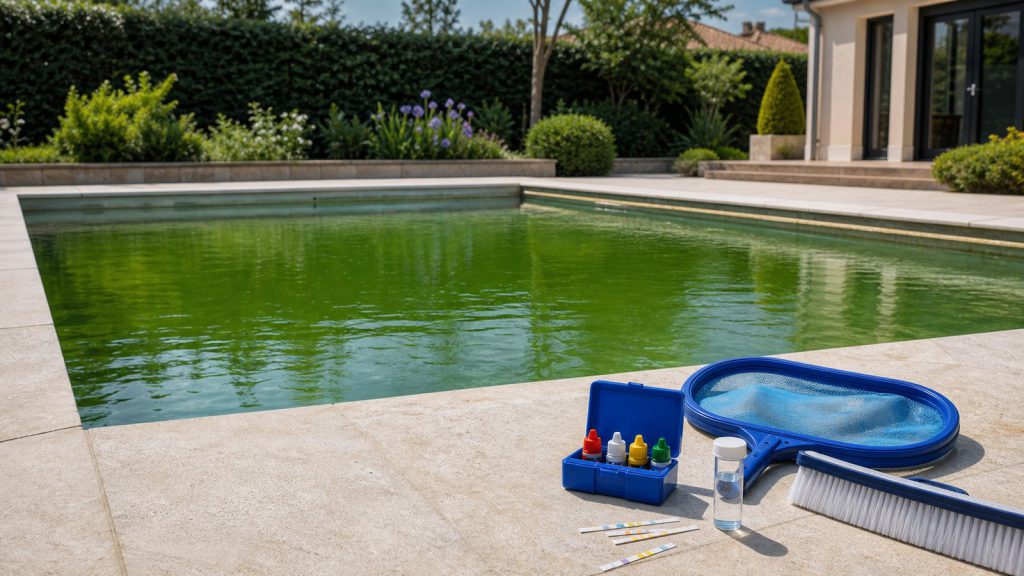
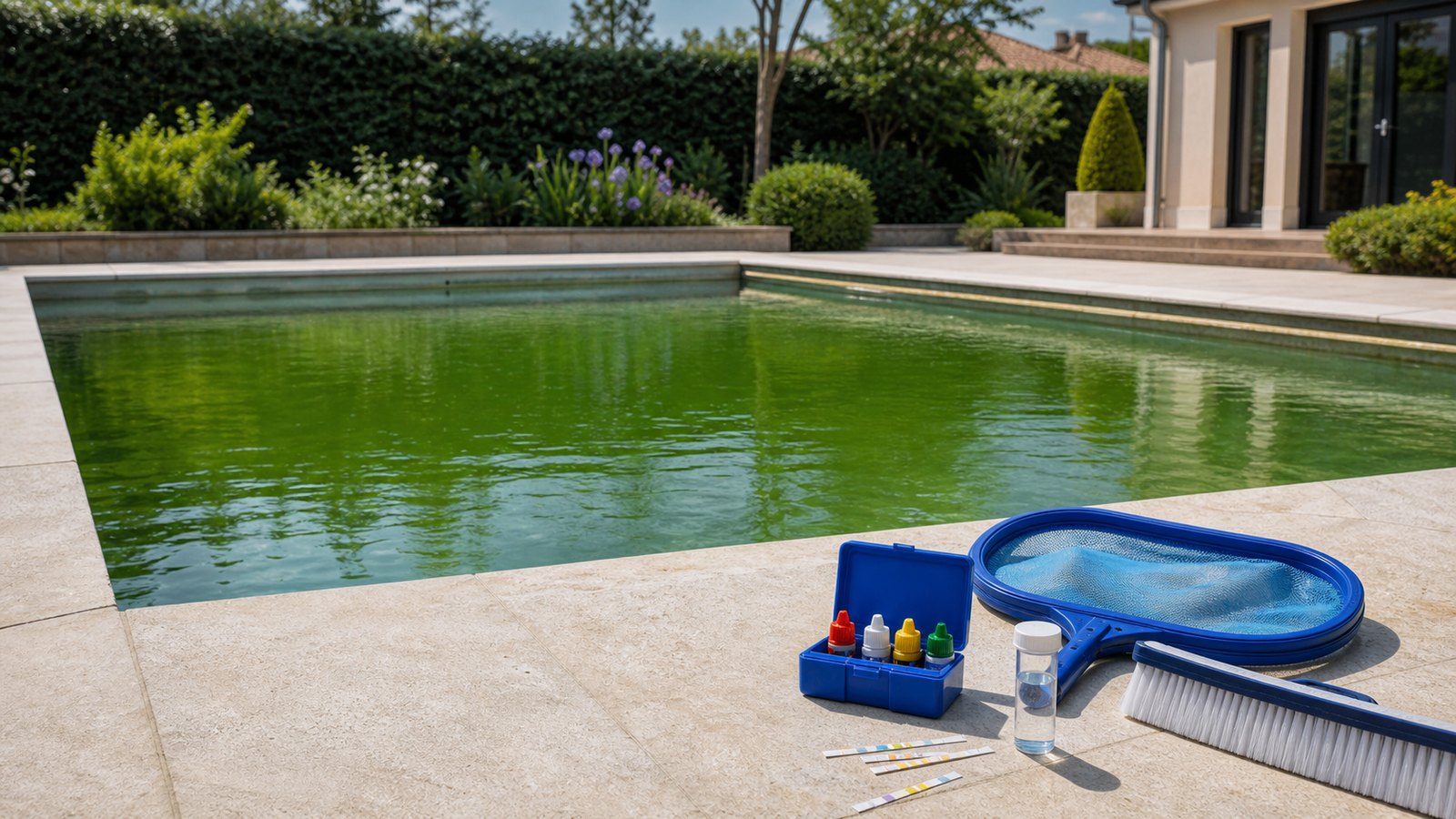
Quick answer: do not deal with black dots and stains in a pool just by adding chemicals. First close the pool to swimming, measure pH and disinfection, identify the pool surface, and mechanically disrupt the stains with a suitable brush. Be careful with liner, plastic and laminate, since a hard brush or localised chemicals can damage the surface. If the stains will not move with a brush, they could also be metals, rust or surface damage.
Black algae often lodges in pores, joints, corners, steps, around lights and in areas with weaker circulation. That is why it likes to come back. Success usually rests on a combination: correct pH, enough disinfection, brushing, filtration, cleaning the filter and checking dead zones.
Black algae and black stains checklist
| Situation | Question | Risk | What to do |
|---|---|---|---|
| Black dots in the joints | are the stains dark, firm, and mainly stuck in the joints, on the steps or in the pores? | black algae sits deeper in the surface, and a normal pass with a brush often just irritates it | close the pool to swimming, measure pH and disinfection, brush mechanically with a suitable brush, and follow the product label for your specific surface |
| Concrete, render or mosaic | is the pool concrete, rendered, ceramic or mosaic? | a porous surface gives algae somewhere to hold on and come back repeatedly | brush more thoroughly than with a liner, treat the joints, steps and corners too, and check for the stains returning over the following days |
| Liner and laminate | is the pool a liner, plastic or laminate pool? | too hard a brush, localised tablets or an aggressive approach can damage the surface and leave permanent marks | use a soft brush and only chemicals approved for that surface; if unsure, it is better to call a service provider or the manufacturer |
| Low chlorine or poor pH | do the readings show low disinfection, high pH or fluctuating values? | algae comes back when the water is not in a measurably good range and the filtration cannot keep up | correct the pH and disinfection first, then deal with shocking/oxidising according to the label; do not add chemicals blindly without measuring |
| Dead residue on the bottom | does grey or dark dust remain on the bottom after treatment? | dead algae and sediment can come back through the filter or make the cloudiness worse | vacuum to waste where possible, clean or backwash the filter and check the pressure/flow |
| Returning after a few days | do the stains come back in the same spots? | the source remains in the pores, joints, behind a light, in the steps or in poorer circulation | repeat the mechanical cleaning, check dead flow zones, the filtration time, the filter and the areas around lights or jets |
| Suspected metal stains | are the stains more rust-coloured, grey, blue-green, or do they not respond to a brush at all? | this may not be algae at all, but metal stains, copper, iron or a reaction between chemicals and the surface | do not keep shocking at random; compare with the article on metal stains and, for an expensive surface, arrange testing/service |
| When to call for service | is this a new, expensive or sensitive surface, extensive stains, or repeated recurrence? | the wrong brush, the wrong chemical or localised dosing can do more damage than the algae itself | have the surface professionally assessed, and prepare photos, water readings, the surface type, the chemicals used and the history of the problem |
Step-by-step procedure
- Close the pool to swimming until you know what the stains are and that the water is in order.
- Measure pH, free chlorine or bromine and, where possible, alkalinity.
- Check whether the stains can be mechanically disrupted with a brush.
- Choose the brush to suit the surface: harder for tough mineral surfaces, softer for liner, plastic and laminate.
- Only treat with chemicals according to the label and the type of pool.
- After treatment, filter, vacuum up the sediment, and clean or backwash the filter.
- Over the following days, watch for the stains returning, and monitor the pH, disinfection and areas with weak circulation.
What not to do
- Do not drop shock or tablets locally onto liner, plastic or laminate without being sure the manufacturer allows it.
- Do not use a metal or overly hard brush on sensitive surfaces.
- Do not assume that an algaecide alone will clear clogged joints without brushing.
- Do not mistake every black stain for algae. Metal stains, rust and surface damage need a different approach.
- Do not leave the filter clogged with dead algae and sediment.
When it might not be algae
If a stain does not change appearance after brushing, is rust-coloured, grey or blue-green, sits near a metal fitting, or appeared after a pH adjustment, an algaecide, well water or salt water, consider metal stains instead. In that case, shocking at random can make the problem worse.
Where to go next
- Pool algae and stains: green, yellow, black
- Green pool water: what to do
- Rust, stainless steel and metal stains
- Slimy walls, slippery steps and biofilm
- Dust on the bottom and debris returning after vacuuming
- Service brief for a water problem
Sources and background
This is based on general safety recommendations for healthy swimming and measurable water values: pH and disinfection must stay within the recommended range, swimming should be closed off when the risk is unclear, and chemicals should be used according to the label and the pool surface.