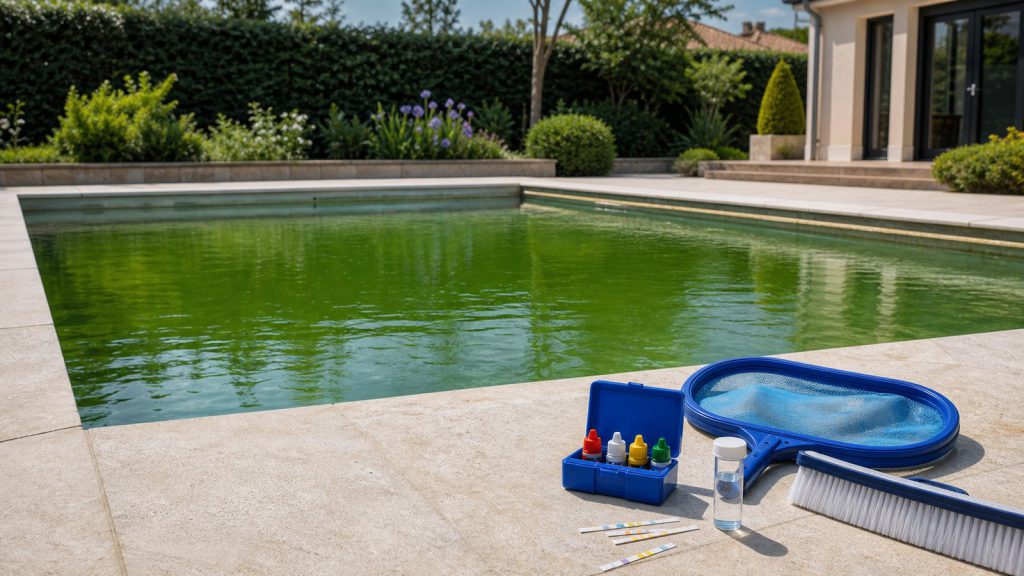
Quick answer: don’t ignore slimy walls or slippery steps even when the water looks clear. Test pH and disinfectant, brush the surfaces mechanically, clean the filter and any dead spots, and for a hot tub think about the pipework too. If the values are uncertain, the water smells, or health symptoms have appeared, stay out of the water.
Biofilm and early-stage algae often don’t start with green water, but with the surface. A slippery step, a slimy waterline, a greasy filter or a smell from the cover mean that a water test alone may not tell the whole story. That’s why you need to combine chemistry, mechanical cleaning and circulation.
Checklist for slimy walls and biofilm
| Area | Question | Risk | What to do |
|---|---|---|---|
| Feel of the surface | are the walls, steps, benches or waterline slippery even though the water looks clear? | early biofilm or algae can be on the surface before the water visibly turns bad | don’t swim if the values are uncertain, brush all surfaces mechanically, and test the water right away |
| Disinfection and pH | are free chlorine/bromine and pH holding within the recommended range? | low disinfectant or poor pH lets microorganisms cling to surfaces and dead spots | correct the pH, confirm disinfectant with a fresh test, and dose according to the water volume and the label |
| Dead zones | is the slime mainly in corners, on steps, under the cover, in the jets or around the skimmer? | areas with weak circulation are harder to clean and biofilm keeps coming back there | hand-brush the detail areas, check jet direction, flow and how long filtration runs |
| Filter and organic load | is the filter clogged, does a greasy waterline remain after swimming, or is a lot of cosmetics used? | organic load uses up disinfectant and feeds biofilm | clean the filter, skimmer, baskets and waterline; after heavy use, extend filtration and testing |
| Hot tub and pipework | is this a hot tub with slime, a smell, foam, or water that hasn’t been drained for a long time? | warm water, jets and pipework can hold biofilm even when the water looks clean | consider flushing the pipework with a manufacturer product, draining, cleaning the filter and starting the water fresh |
| Cover and enclosure | is there also slime on the underside of the cover, the thermal cover, or in damp seams? | the cover can return organic matter to the water and hold a damp microclimate | clean the cover and let it dry as instructed, and check for smell and condensation |
| Problem returning | do the slippery walls come back within a few days of cleaning? | the cause can be low flow, short filtration, poor dosing, high CYA or clogged pipework | keep a log of values, check CYA, alkalinity, filtration time, bather load and the state of the equipment |
| When to call a service technician | is the slime linked to a smell, a rash, coughing after the hot tub, or uncertain disinfection? | this can be a health risk, especially with hot tubs and jet aerosols | close the water, prepare a history of readings, photos of the surfaces, the filter’s condition, and contact a service technician; see a doctor for health symptoms |
Step-by-step procedure
- Stop swimming if the water is uncertain, smells, foams, or you don’t know the current values.
- Test pH, free chlorine or bromine, temperature, and depending on the situation, alkalinity, CYA or hardness.
- Brush the steps, corners, waterline, jets, skimmer, benches and areas under the cover.
- Clean the filter, baskets and the pump’s pre-filter; watch the flow and pressure.
- Adjust pH and disinfectant according to the product label and the water volume.
- Extend filtration and, after brushing, vacuum or clean up the settled debris again.
- For a hot tub with recurring slime or smell, deal with flushing the pipework, draining and a fresh start.
- If the problem keeps coming back, look for the cause in circulation, the cover, CYA, the filter, dosing or a high bather load.
Common mistakes
- Relying only on the water looking clear and not touching the walls, steps or waterline.
- Adding chemicals but not brushing the biofilm off the surface.
- Treating only the water and not the filter, skimmer, cover and areas with weak flow.
- For a hot tub, dealing only with the water in the shell and not the pipework and jets.
- Not keeping a log of readings, so you don’t notice when disinfectant drops toward zero.
- Ignoring health symptoms after a hot tub, especially coughing, fever, breathlessness or a rash.
Where to go next
- Restarting a hot tub after downtime, odor and biofilm
- Hot tub, hygiene, rash and Legionella
- Algae and stains in a pool
- Sunscreen, cosmetics and foam
- Pool filtration and pump
- How to test the water correctly
- Service brief for a water problem
Sources and context
This guide draws on CDC Healthy Swimming requirements for disinfectant, pH, filtration and removing biofilm, on CDC guidance on hot tubs and Legionella, and on industry explanations of biofilm as a microbial layer on wet surfaces. For specific disinfection, pipe cleaning and filtration, the product label and manufacturer’s manual always take precedence.