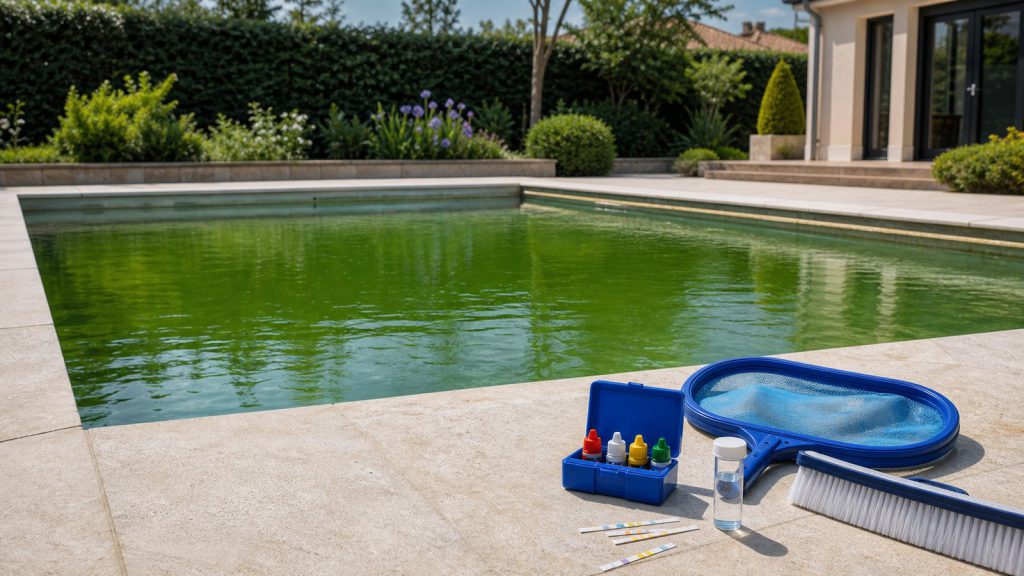
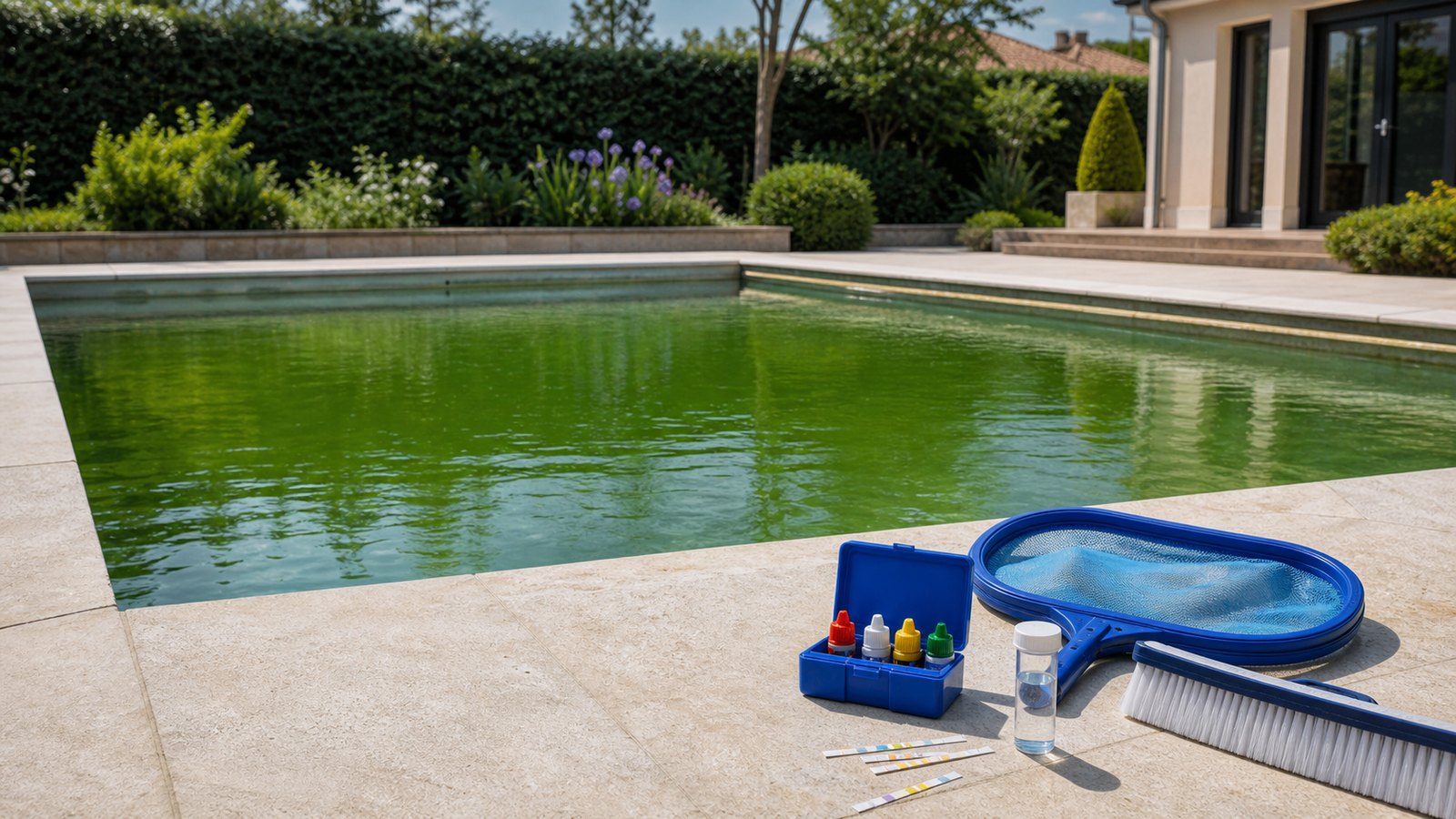
Quick answer: green water is most often algae combined with weak effective disinfection; yellow dust can be mustard algae or pollen; black dots can be black algae, a metal stain or surface damage. Before adding any chemicals, measure the water, brush the surface, check the filtration, and work out whether you are dealing with a coating that wipes off or a stain that stays put.
Algae is not just “too little chlorine”. It is often a combination of pH, weak circulation, a dirty filter, organic load, heat, shade and contaminated accessories. That is why the problem comes back even when the water looks better for a while after treatment.
Decision table: algae, a stain, or dirt
| What you see | What it could be | The first correct step | Common mistake |
|---|---|---|---|
| Green water or a green coating | green algae, low effective disinfection, weak filtration or organic load | measure pH and disinfection, mechanically remove debris, brush the walls and let the filtration run longer | adding more products at random without measuring and without cleaning the filter |
| Yellow or sand-like dust in shaded spots | mustard algae, pollen, fine dust, or debris settled in dead zones | try wiping the spot with a brush, check whether it comes back, test the water and clean any accessories that return it to the water | only treating the pool floor and leaving spores on the brush, the cleaner, the steps, toys or a cover |
| Black dots or dark patches on render and joints | black algae, a metal stain, an organic stain or surface damage | check whether the stain can be brushed and whether it is slimy; for stubborn stains and sensitive surfaces it is better to call for service | scraping the surface with a metal tool or adding more chemicals without working out whether it is a metal or damage |
| Brown, rust-coloured or red stains after filling | iron, manganese, copper, well water or a reaction between metals and chemicals | do not mistake metal discolouration for algae; measure the water and follow the procedure for well water and metals | shocking the water again and again when the cause may be a metal, not living growth |
| Slippery steps, skimmer, corners or the waterline | biofilm, grease, cosmetic residue, weak circulation or insufficient mechanical cleaning | brush the problem spots, clean the baskets, the filter and the waterline, and check the circulation | relying only on chemicals when biofilm needs to be broken up mechanically |
| Algae returns after a few days | an unresolved cause: too little filtration, high load, poor pH, a clogged filter, dead spots or contaminated accessories | log the readings, check the filtration time, pressure, flow and everything that returns to the water | buying yet another different product instead of finding the operational cause |
| The water is clear, but the walls have marks | early-stage algae, metals, limescale, organic stains or a shadow on the surface | work out whether it is a coating that wipes off, a fixed stain or an optical effect; choose chemicals, cleaning or service accordingly | judging only the colour of the water and ignoring the pool surface |
| The water turns milky after cleaning | dead algae, fine particles, poor filtration, high pH or overloaded water | let the filtration work, clean the filter, vacuum fine sediment and measure pH and disinfection | immediately adding another shock dose without giving the filtration time or checking the readings |
A procedure without wasting chemicals
- Photograph the problem in daylight and note where it appears.
- Take a water sample and measure pH, disinfection and, depending on the situation, alkalinity.
- Mechanically remove leaves, dust and organic matter before you start dosing.
- Brush the walls, steps, corners, joints, the skimmer and the waterline.
- Clean the filter, the baskets, the pre-filter and any accessories that return debris to the water.
- Dose only products intended for your type of pool and according to the manufacturer’s label.
- After treatment, filter, watch the pressure, and vacuum fine sediment according to your filtration type.
- If the problem returns, address the circulation, filtration, surface, metals or arrange a service diagnosis.
When to call for service
- Black or dark stains sit in the render, joints or liner and cannot be safely wiped off.
- You suspect metals from well water, rust, copper or discolouration after chemicals.
- Algae keeps coming back even after brushing, filtration and correct measuring.
- It is unclear whether a specific product is safe to use on liner, stainless steel, stone or mosaic.
- The filtration has weak flow, high pressure, sand in the pool or other technical symptoms.
Where to go next
- Green pool water
- Water diagnostics by symptom
- Well water, iron and manganese
- Pool filtration and pump
- Filtration runtime calculator
- Photos for a service enquiry
Sources and background
For general principles we draw on the CDC for the importance of pH and disinfection, Health Canada for the safe use of pool and spa chemicals, the NPIC for the role of sanitisers and algaecides, and Ask Extension for caution when identifying mustard algae. Always follow the product label and your pool surface type for the specific dose.