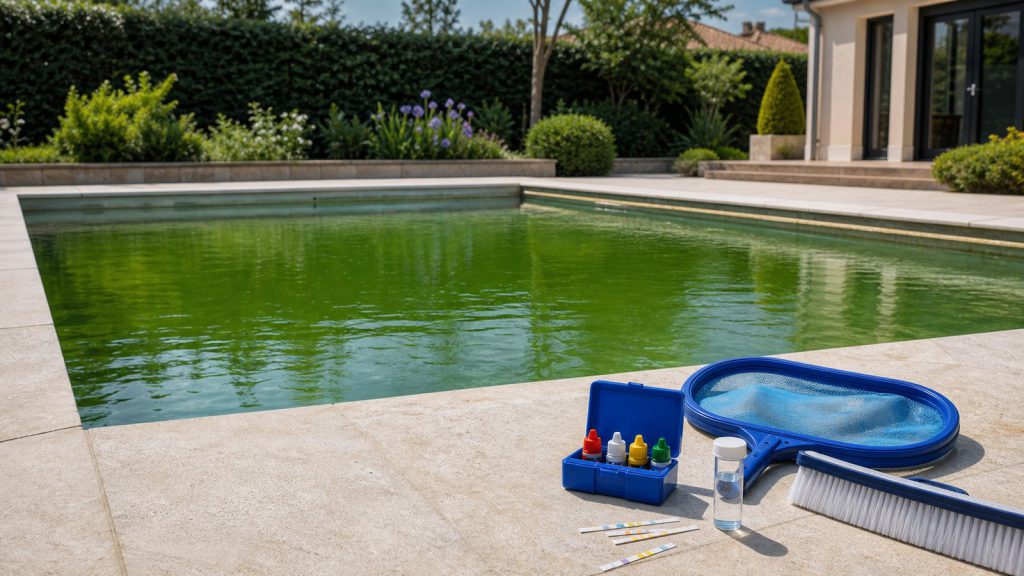
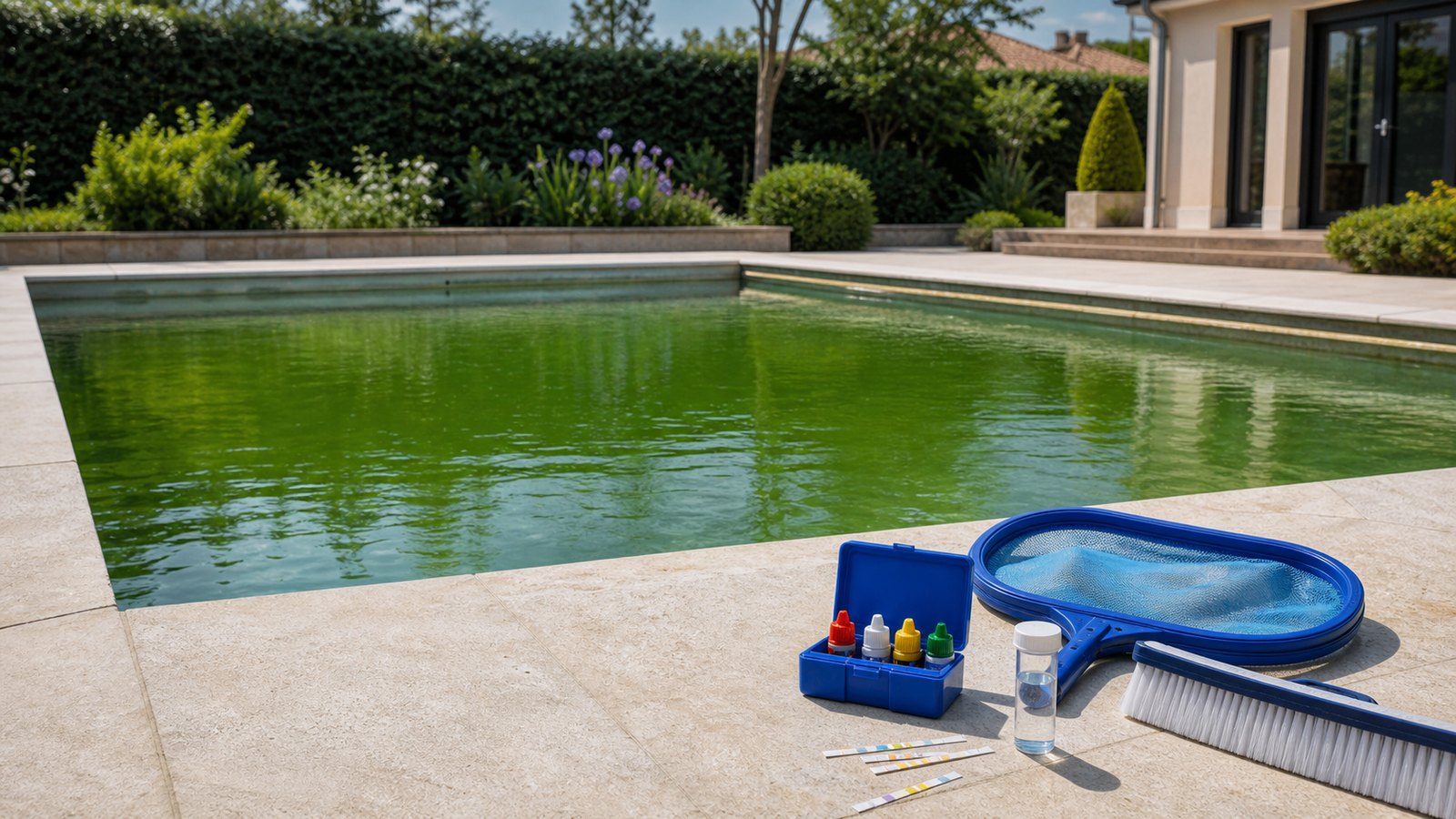
Quick answer: when the water turns red, brown, or leaves rust-coloured marks after filling, chlorine or shocking, it is often not “dirt” but iron, manganese or corrosion of metal parts. Close the pool to swimming, measure pH and disinfection, do not add more chemicals blindly, and let the filtration work. For well water, note the source, the volume, and everything you have added to the water.
A typical situation: the pool looks clear after filling, but within hours of adding chlorine it turns red, orange or brown. This often means dissolved metals in the water have oxidised. Similar stains can appear on the steps, near stainless steel, around screws, in corners or on the waterline.
Red and brown water checklist
| Situation | Question | Risk | What to do |
|---|---|---|---|
| Water turned brown after chlorine | was the water clear, and did it turn brown after adding chlorine, shock or oxidiser? | dissolved iron or manganese may have oxidised and changed the water colour or left stains | close the pool to swimming, measure pH and disinfection, do not add more shock blindly, filter, and treat the metals according to the product label |
| Well or tanker water | did you fill from a well, a borehole, an old tanker or an unknown source? | groundwater often carries iron, manganese and hardness, which only show up after chlorine or a pH change | next time test the source before filling; for now note the source, the volume, the products used, and watch the filter |
| Rust-coloured edges and steps | are there rust-coloured, orange or brown marks around the steps, screws, stainless steel fittings or the waterline? | this can be iron, corrosion of metal parts, low pH, or a poor combination of salt water and stainless steel | do not scrape the surface aggressively, check the pH, metals and metal fittings, and photograph a new stain for service |
| Dark brown stains | are the stains dark brown, blackish brown or purplish black? | manganese can leave dark stains and is easily mistaken for black algae | compare with the article on black algae; if a stain does not respond to a brush, do not treat it as algae without testing for metals |
| Low pH | has the pH been low for a while, or did you add too much pH minus? | more acidic water can promote corrosion and release metals from the equipment, heat exchanger, ladder or screws | correct the pH gradually according to the label, check the metal parts, and do not overdo further chemicals |
| Clogged filter | does the filter darken quickly, does the pressure rise, or does brown cloudiness return after vacuuming? | oxidised metals and fine sediment can clog the filter or return to the pool | backwash/clean the filter, vacuum the sediment to waste where possible, and monitor the flow |
| Hot tub turned brown | is this a hot tub with a small volume and warm water? | a small volume reacts faster, and poor water is harder to rescue without overdosing chemicals | for a strongly browned hot tub, it often makes sense to drain the water, clean the filter and refill from a confirmed source |
| When to call for service | are the stains on an expensive surface, near stainless steel, after new equipment, or do they repeat after every fill? | the wrong metal remover, acid or brush can damage the surface | prepare photos, pH/disinfection readings, the water source, the pool type and a list of chemicals used, for service |
What to do right away
- Close the pool to swimming until you know whether the water is disinfecting and what caused the discolouration.
- Measure pH, free chlorine or bromine and, where possible, alkalinity.
- Photograph the water colour and the stains before doing anything else.
- Do not add more shock or acid without measuring and checking the label.
- Keep the filtration running, watch the filter pressure, and clean the filter more often.
- If there is sediment on the bottom, vacuum it to waste where possible.
- For well water, consider testing for iron, manganese and hardness before the next fill.
What not to do
- Do not keep adding chlorine repeatedly just because the water is brown.
- Do not scrape stains with sharp metal or a hard brush on a sensitive surface.
- Do not use acids or stain removers without checking the pool surface.
- Do not automatically assume manganese or iron stains are algae.
- Do not ignore low pH, since it can promote corrosion of equipment and metal fittings.
How to recognise iron, manganese and rust
Iron often causes yellow, orange, red or brown discolouration and rust-coloured stains. Manganese tends to be dark brown to blackish brown and can be mistaken for black algae. Corrosion of metal parts often shows up locally near screws, the ladder, the heat exchanger, welds, stainless steel, or after a period of low pH.
Where to go next
- Well water in pools and hot tubs
- Rust, stainless steel and metal stains
- Filling a pool from a well, mains or tanker
- Black algae and black stains in a pool
- Water hardness and limescale
- Service brief for a water problem
Sources and background
This is based on public recommendations for healthy swimming and expert water-industry sources on iron and manganese: iron often causes yellow, red and brown discolouration, manganese dark brown to black stains, and disinfection/pH should be measured regularly.