Last updated: 14 July 2026
The price of a turnkey pool isn’t determined by the shell alone. What really moves the budget is excavation, equipment, enclosures, heating, electrics, transport and after-handover service — and these are exactly the line items that explain why two quotes for “the same” pool can differ by hundreds of thousands of crowns. This article sets out indicative price bands for 2026 by pool type, shows what’s typically included in the price and what isn’t, and explains where the budget really breaks down — so you can compare suppliers’ quotes on the same basis. In Czechia, a turnkey pool typically costs from around 380,000 Kč upward, depending on construction type, as set out below.
How much a turnkey pool costs by construction type
The following ranges apply, roughly, to a typical family in-ground pool of around 40–70 m³ (typically about 3 × 8 m, 1.2–1.5 m deep) supplied on a turnkey basis, i.e. including basic groundworks, installation and equipment. They do not apply to above-ground or inflatable pools, whose purchase price is an order of magnitude lower. Prices are indicative, checked with suppliers as of 7/2026 — for a specific plot and scope of supply they may vary in either direction by tens of percent.
| Pool type | Turnkey price (indicative, 7/2026) | Characteristics |
|---|---|---|
| Liner / skimmer pool | 380,000 – 900,000 Kč (approx. €15,000 – €36,000) | The most affordable option, steel or polystyrene structure, PVC liner shell, skimmer filtration |
| Composite (fibreglass) | 550,000 – 1,400,000 Kč (approx. €22,000 – €56,000) | Prefabricated shell, fast crane installation, available in both skimmer and overflow versions |
| Concrete / ceramic-tiled | 950,000 – 2,500,000 Kč (approx. €38,000 – €100,000) | Reinforced-concrete structure, waterproofed with a liner or ceramic tiling/mosaic, any shape, usually an overflow system |
| Stainless steel | 1,700,000 – 4,200,000 Kč (approx. €68,000 – €168,000) | Welded stainless-steel tank, overflow system, premium finish and long service life |
Liner / skimmer pool
The most common and most affordable type. The structure is a steel or polystyrene shell, or sometimes a brick or concrete-ring pit, with a PVC liner shell and skimmer-drawn water. The lower price is offset by the liner’s shorter lifespan — typically 10–15 years before it needs replacing.
Composite (fibreglass) pool
The shell is manufactured as a single piece in a factory and delivered ready-made to the site — installing the shell itself takes days, not weeks. This shortens the build time but increases the requirements for site access for machinery (crane, trailer).
Concrete / ceramic-tiled pool
A reinforced-concrete structure allows any shape and size, including unconventional designs. The surface is usually finished with a liner or ceramic tiling and mosaic — the latter is more expensive but more durable. An overflow system is common with concrete pools and, on its own, raises the cost of the equipment compared with a skimmer.
Stainless steel pool
A welded stainless-steel tank is a premium segment in Czechia — the higher purchase price is offset by minimal surface maintenance and a long service life without the need for refurbishment.
What is and isn’t included in a “turnkey” price
Every supplier interprets “turnkey” a little differently. It’s precisely the items below where prices most often come as a surprise.
| Item | Usually included in the turnkey price | When it’s billed separately / what to watch |
|---|---|---|
| Excavation and soil removal | Yes, in most quotes | Price rises with restricted machinery access, rocky subsoil or a high water table |
| Base slab / gravel bedding | Yes | For concrete pools this is subject to a structural calculation and can raise the price depending on the subsoil |
| Pool shell and waterproofing | Yes | The surface type (liner vs. ceramic/mosaic) affects both price and future lifespan |
| Filtration, pump, pipework | Yes, at baseline capacity | Capacity must match the water volume — undersized filtration is a hidden extra cost later |
| Electrical installation to the pool | Often only partially | The connection from the house’s distribution board, and any upgrade to it, is often a separate item |
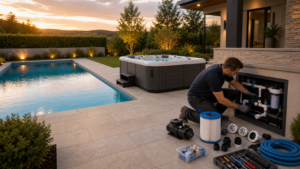
| Technical/inspection shaft | Often not | Without it, servicing the equipment is difficult — a common place where cheaper quotes cut corners |
| Steps, edging, surround paving | Partially | Basic edging is usually included; a larger terrace and paving is usually separate |
| Enclosure | No | Practically always a separate item, priced according to type, from low-profile to high enclosures |
| Water heating (heat pump, solar, electric) | No | Handled as an add-on based on output and chosen heat source |
| Transport and crane | Partially | For composite and stainless-steel pools, depends on distance and site accessibility |
| Start-up, training, initial chemicals | Yes, with more reputable suppliers | Confirm in advance so it doesn’t turn into an additional invoiced item |
| Safety features (cover, alarm, fencing) | No | Recommended for safety reasons, but not always included or offered automatically |
Where the price really breaks down
Besides the type of construction, five factors affect the final price that often don’t appear in a manufacturer’s base price list at all.
Size and water volume
Price doesn’t scale linearly with size — a larger shell means more excavation, stronger equipment and higher structural demands.
Site accessibility
If heavy machinery can’t reach the plot (narrow access, a slope, distance from the road), excavation, manual labour and transport costs all rise — for composite and stainless-steel pools, poor access can mean a difference of hundreds of thousands of crowns.
Equipment type: skimmer vs. overflow
An overflow system (a channel around the full perimeter, a balancing tank, more powerful pumps) is more demanding to build and to run than a skimmer system.
Enclosure
A low-profile enclosure costs on the order of tens of thousands of crowns; a high, year-round heated enclosure costs hundreds of thousands — and extends the season.
Location and transport
Distance from the manufacturer or installation company affects the cost of transporting both materials and machinery. In regions with fewer suppliers, quotes for the same type of pool also tend to be more expensive.
Running costs in the first year
The purchase price is only the first part of the budget. Several recurring and one-off items are added to it in the very first year:
- Pool chemicals – pH adjustment, disinfection and shock chlorination for the whole season.
- Electricity for filtration – the pump runs several hours a day throughout the swimming season.
- Electricity or gas for water heating, if the pool has a heat pump, solar heating or an electric heater — for a heated pool, this is the single largest running cost.
- Spring start-up and autumn winterisation – either done yourself or by a contracted company.
- Annual equipment service check, plus any electrical inspection.
For a typical family pool without an enclosure or heat pump, the first year of operation usually runs to a low tens-of-thousands of crowns; for a heated pool with a longer season, considerably more.
How to compare quotes so price alone doesn’t decide
People often compare only the price of the shell or the equipment set. It’s fairer to build the budget as a whole project. Before deciding based on the lowest number on a quote, go through:
- Pool type, dimensions, depth and how it’s set into the ground.
- Groundworks, soil removal, concreting or the base slab.
- Filtration, pipework, jets, skimmer or overflow, inspection shaft and electrical installation.
- Water heating, covers, enclosure and safety features.
- Terrace, edging, steps, lighting and surrounding landscaping.
- Start-up, training, initial chemicals and service availability.
If you have two or more quotes on the table, a detailed walkthrough of how to compare them item by item is in the article how to compare two pool or hot tub quotes.
The most common mistakes when requesting quotes
- Comparing quotes that don’t cover the same scope of supply. The lowest price often means a missing inspection shaft, weaker filtration, or no start-up service.
- Forgetting about the electrical inspection and site readiness. Without them, the build is delayed and the costs shift onto you.
- Choosing the cheapest filtration regardless of water volume. Undersized equipment only shows up once you’re running the pool — through higher chemical use and poorer water quality.
- Not asking who handles complaints after handover. Service availability matters as much as the purchase price.
How to decide
The best quote isn’t always the lowest price. The winner is the supplier with a clear scope of supply, well-handled equipment integration, reasonable running costs and a service plan after handover. Questions worth asking every supplier: what exactly is included in the price and what’s an extra item, who is responsible for excavation, concrete, electrics and drainage, what are the running costs in a typical season, how quickly will the company come out for service during the season, and will you get an equipment diagram and a handover protocol in advance.
Want an exact price for your plot? Submit a request and compare up to 3 quotes from vetted suppliers — you’ll save time and the risk of comparing quotes that don’t match each other in scope.
Frequently asked questions (FAQ)
How much does a turnkey pool cost in 2026, roughly?
Depending on the construction type, from around 380,000 Kč (approx. €15,000) for a simple liner skimmer pool up to 4,000,000 Kč (approx. €160,000) or more for a premium stainless-steel overflow pool. The deciding factors are shell type, size, equipment, enclosure and site accessibility — prices are indicative, checked with suppliers as of 7/2026.
Which type of pool is the most affordable?
A liner (skimmer) pool with a steel or polystyrene structure. The lower purchase price is offset by the liner’s shorter lifespan (10–15 years) and the need to replace it later.
What’s typically included in a “turnkey” pool price?
Usually excavation, the base slab, the pool shell, waterproofing, basic filtration and installation. Enclosure, water heating, a terrace and safety features are typically separate items — always get the scope of supply itemised in writing.
How much extra does a pool enclosure cost?
A low-profile enclosure costs on the order of tens of thousands of crowns; a high, year-round heated enclosure costs hundreds of thousands of crowns. An enclosure also extends the swimming season, so it’s worth factoring into the running-cost side too.
How much more expensive does a poorly accessible plot make a pool?
Restricted access for machinery raises the cost of excavation, manual labour and transport. For composite and stainless-steel pools installed by crane, poor access can mean a difference in the order of hundreds of thousands of crowns compared with an easily accessible plot.
How much does running a pool cost in the first year?
It depends on size, heating and season length — without an enclosure or heating it’s usually a low tens-of-thousands of crowns a year, with a heat pump and a longer season, considerably more.
How do I know if a quote is suspiciously cheap?
If it’s missing an inspection shaft, electrical inspection, or start-up service, or the filtration is undersized for the water volume, the quote probably doesn’t cover the full scope you’ll need. Always compare item by item, not just the total amount.
When is the best time to request a pool quote?
Ideally outside the main season, so in autumn or winter. You’ll get more time for the project, site preparation and comparing suppliers’ quotes.
Will I save money by doing some of the work myself?
Partly, yes – typically with landscaping, the terrace or fencing. For excavation, waterproofing, electrical installation and connecting the equipment, doing it yourself doesn’t pay off: a mistake leads to warranty disputes and, in the final tally, often costs more than leaving it to a professional company.
Sources and editorial note
- Piscine Global – industry trade-fair coverage of pools and wellness
- Pool & Hot Tub Alliance – consumer and safety resources
- Energy Saving Trust – household energy savings
This article is an editorial guide for orientation before requesting quotes. The price bands given are an indicative estimate of market ranges as of 7/2026, not a binding offer — always verify the exact price, technical parameters and warranties with a specific supplier, designer or service company.
Next step
Planning a similar pool, hot tub or wellness project?
Move from inspiration to the company directory, a clear request or a regular editorial selection.