
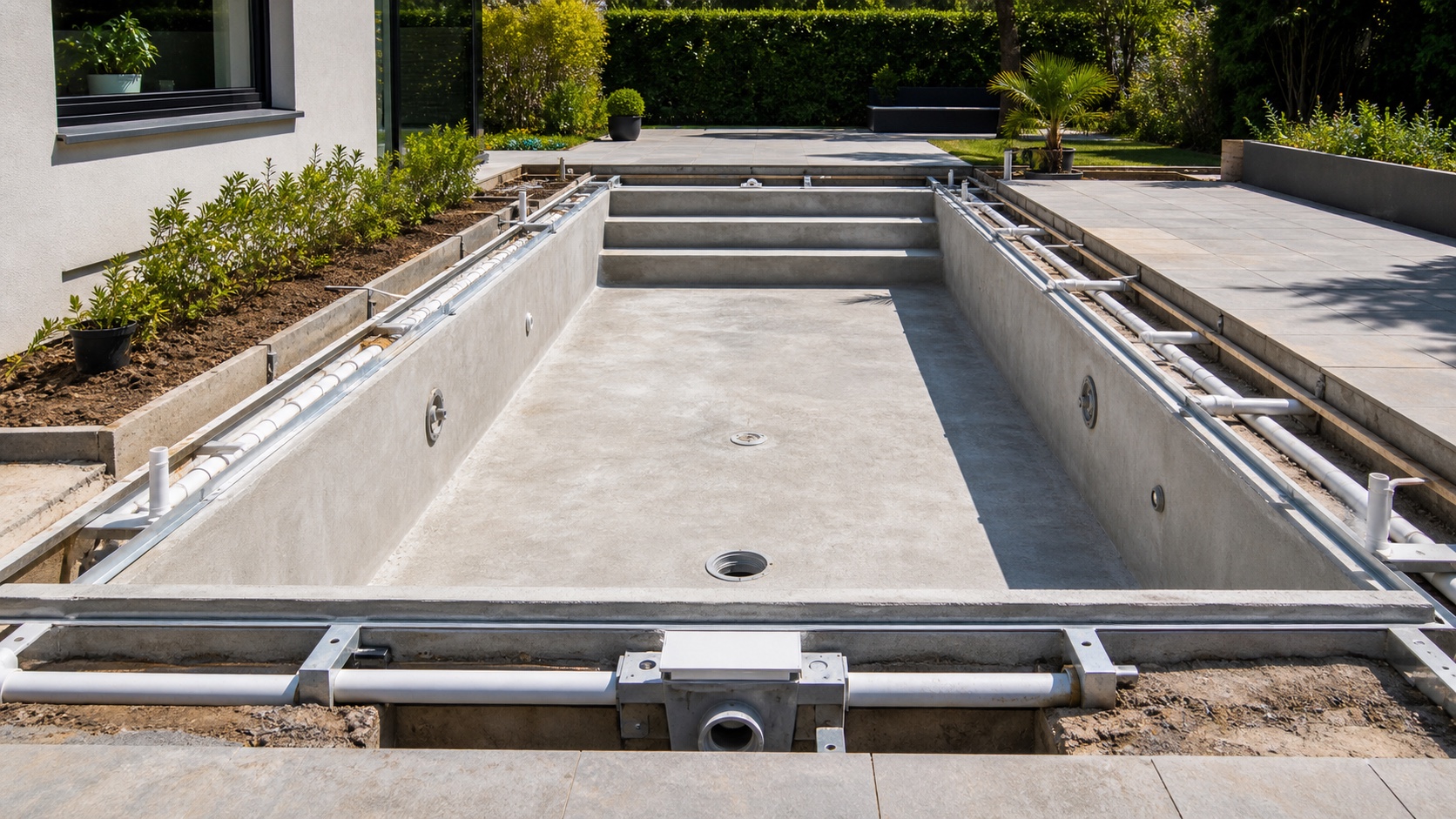
Quick answer: after cement, concrete dust, plaster or dust from cutting tile falls into the pool, don’t swim. First stop any further dusty work near open water, remove the dust mechanically, clean the skimmer and filter, test pH, alkalinity and disinfectant, and keep checking filtration repeatedly. Chemicals alone won’t remove construction dust from a pool.
Construction dust is a different problem from ordinary pollen. It can be very fine, alkaline, hard on filtration, and easily stirred back up by dry cleaning methods. With cement, grout and cutting stone, it’s also not just about the water — protecting your breathing while working near the pool matters too.
Checklist after construction dust in the pool
| Area | Question | Risk | What to do |
|---|---|---|---|
| Stop swimming | has cement, concrete dust, grout, plaster or cutting dust fallen into the water? | fine mineral dust can irritate, raise pH, cloud the water and clog the filter | don’t swim until the water is clear, the values are tested and the mechanical debris is removed |
| Protecting people | is dust still in the air, or is stone, concrete or tile being cut near the pool? | fine construction dust and respirable crystalline silica are risky mainly when inhaled | pause dusty work near open water, use wet cutting, extraction, and personal protection suited to the job |
| Mechanical cleaning | is the dust sitting on the surface, the bottom, the steps, the edge or the waterline? | chemicals alone won’t remove dust, and stirring it up can spread the problem through the whole volume | skim the surface, brush carefully, vacuum slowly, and where possible vacuum to waste rather than through the filter |
| Filtration | is filter pressure rising, is flow weakening, or is dust coming back through the jets? | fine dust can quickly clog sand, a cartridge, a robot cleaner and the pre-filter | clean the baskets and cartridges, backwash according to pressure, and for fine dust consider a flocculant only if suited to your filter type |
| pH and alkalinity | have you tested pH and alkalinity after contact with cement, concrete or grout? | cement-based materials tend to be alkaline and can push pH out of the safe range | test, adjust in small doses per the label, and re-test once the water has mixed |
| Pool surface | is the pool liner, laminate, stainless steel, tile or concrete? | harsh brushes, acids or the wrong process can damage the surface or the grout lines | choose cleaning suited to the material, and don’t experiment with acid on stains or deposits without the manufacturer or a service technician |
| Hot tub | did construction dust get into the hot tub, its filters or around the jets? | a hot tub’s small volume and pipework clog faster, and fine dust can stay in the system | don’t use the hot tub, clean the filter, change the water depending on how contaminated it is, and address a restart if dust is in the pipework |
| Prevention during work | will there be more cutting, grinding, grouting or plastering near the pool? | repeated dust fall undoes previous cleaning and can drive up service costs | cover the water and equipment, plan wet cutting away from the wind, clean up wet after the work, and only then uncover the pool |
Step-by-step procedure
- Stop swimming and any further dusty work near uncovered water.
- If cutting or grinding is still going on, cover the pool, the skimmer, the equipment and shield against the direction dust falls.
- Skim the surface, and clean the waterline, steps, edges and skimmer.
- Vacuum the bottom slowly. For heavy dust, vacuuming to waste rather than through the filter is better if your equipment allows it.
- Clean the pre-filter, the cartridge, or backwash the sand filter depending on the pressure.
- Test pH and alkalinity, adjust in small steps, and re-test once the water has mixed.
- Keep an eye on filtration the next day too, since fine dust often settles on the bottom again.
Common mistakes
- Adding a shock dose and expecting the mineral dust to disappear.
- Sweeping dry cement dust toward the pool.
- Using acid or a surface cleaner without checking what the pool is made of.
- Running a robot cleaner with an unsuitable filter and just stirring up the fine sediment.
- Cutting tile near an uncovered pool, against the wind, without covering the water.
Where to go next
- Pollen, dust and fine sediment in a pool
- Pool filtration and pump
- Robotic cleaner not cleaning well
- pH and alkalinity calculator
- Water values cheat sheet
- Service brief for a water problem
Sources and context
This guide draws on CDC recommendations for controlling pH and disinfection in pools and hot tubs, on NIOSH/OSHA principles for controlling construction and silica dust with wet methods and extraction, and on pool-care practice around fine mineral dust, filtration and high pH. Always follow the product label, the pool’s material and the equipment manual for specific dosing and surface cleaning.