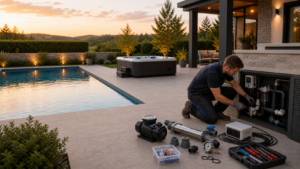
Black spots on the pool floor or in the grout lines are the most stubborn version of an algae problem. While ordinary green water clears up after a few days of over-chlorination and filtration, black algae often doesn’t respond to the same treatment at all — a few days later it reappears in exactly the same spot. That’s not bad luck or weak chemicals. Black algae builds a protective biofilm layer around itself and anchors deep into pores, grout lines and seams that disinfectant struggles to reach. This guide explains why the standard approach fails, what exact sequence of steps works, what chlorine levels and contact times you actually need, and how to keep your water maintained from spring through autumn so black algae never gets a foothold in the first place.
Why black algae is worse than ordinary green water
Green discolouration is usually caused by free-floating algae dispersed throughout the whole volume of water — which is why an increased chlorine dose mixed through the whole pool works well against it. Black algae works completely differently. It’s a colony of attached organisms that clings firmly to a surface and builds a slimy biofilm layer around itself. That layer acts as a shield: it protects the cells underneath from contact with disinfectant, and chlorine that would kill free-floating algae within hours never even reaches the core of the colony.
The second problem is location. Black algae picks exactly the spots where water circulation doesn’t reach with full force and where a brush struggles to reach too — grout lines between tiles, rough patches in render, seams in a liner pool, steps, corners, and nooks behind jets. The combination of a protective biofilm and a hard-to-reach spot is why “just add a bit more chlorine” typically doesn’t work on black algae the way it does on green water — here, mechanical intervention and chemicals have to work hand in hand, in the right order and with sufficient intensity.
Long-neglected fundamentals make it worse too: if disinfection has been running low for weeks, the surface is rougher or more porous (older render, damaged liner), circulation is weak due to poorly set-up filtration, or unwashed brushes and tools keep coming in from another pool, the risk of black algae taking hold rises sharply.
Step-by-step process
Follow the steps below in the order given. Skipping step 1 (mechanical disruption) is the most common reason shock chlorination “doesn’t work” on black algae — the chlorine simply never gets under the protective layer.
1. Adjust the pH
Before dosing anything, measure and adjust pH to 7.2–7.4. Outside this range, chlorine’s effectiveness drops significantly.
2. Mechanically break up the biofilm with a brush
Using a stiff brush — a wire brush for tiles and concrete, a softer one designed specifically for liners on liner pools — scrub thoroughly over every visible spot and its immediate surroundings. The goal is to physically tear open the protective biofilm layer so disinfectant can reach the algae cells. On liners and other sensitive surfaces, always use a brush specifically rated for that material.
3. Carry out shock chlorination at a higher concentration
Immediately after brushing, shock-dose chlorine well above the normal operating range. While standard operating free chlorine sits around 1–3 mg/l, a shock aimed at black algae targets free chlorine of roughly 10 mg/l (higher still for a severe infestation, always depending on the specific product). After dosing, let the chlorine work for at least 8 hours, ideally 12–24 hours, with the filtration circuit running.
4. Apply an algaecide specifically labelled for black algae
An ordinary general-purpose algaecide is often not enough against black algae. Choose a product that the manufacturer explicitly states is effective against black/blue-green algae. Apply it according to the instructions, usually after shock chlorination once the biofilm has already been broken up.
5. Filter continuously and clean the filter
Throughout the treatment, keep the filtration running continuously, ideally 24 hours a day, until the water clears and the spots disappear. After the treatment, backwash the filter — a clogged filter full of dislodged algae is one of the most common reasons black algae comes back within days even after a seemingly successful treatment.
6. Repeat over several days
One round of brushing and shocking is usually not enough for a well-established colony. Repeat the sequence — brush, shock dose, filtration — daily for 3 to 5 days, until the spots are definitively gone and don’t return even after two weeks of normal operation.
What to avoid
- Don’t dose chemicals without measuring. Adding chlorine or algaecide “by eye” without a test kit leads either to underdosing or overdosing.
- Don’t mix different disinfection systems without checking compatibility in the instructions.
- Don’t wait for the problem to get worse. Small black dots left for “next time” keep spreading.
Prevention going forward
- Test the water regularly and keep a log of treatments.
- Keep the filtration and filter clean — a clogged filter means weaker circulation exactly where black algae likes to settle.
- React immediately after heavier pool use — after a busy weekend, a storm, or an extended hot spell, check and adjust disinfection right away.
- Follow the manufacturer’s instructions for the pool, the liner, and the chemicals used.
- Don’t use brushes and tools shared with other pools without cleaning them properly first.
Regular water testing is the foundation of prevention not just for black algae, but for the more common issue of cloudiness and green water too — if you’re dealing with a greenish tinge rather than solid black spots, see the article green pool water: what to do.
When to call in a service company or professional
Call a service company or professional if black algae keeps coming back after two full rounds of this process, the water smells, people in the household report irritation after swimming, or you’re not confident about the correct dosing and technology for your pool.
Not confident doing a serious intervention yourself, or want to make sure it’s done right the first time? Submit a request and compare quotes from vetted service companies in your area, or find a company directly in the directory by region and specialisation.
Frequently asked questions (FAQ)
Should I adjust pH first, or go straight for a higher chlorine dose?
Always measure and adjust pH to 7.2–7.4 first. Outside this range, disinfection works much less effectively.
What free chlorine level do I need for black algae?
The normal operating range is 1–3 mg/l, but for shock chlorination against black algae you’re targeting a significantly higher level, roughly around 10 mg/l free chlorine.
How long does the chlorine need to work after a shock?
At least 8 hours, ideally 12 to 24 hours, with filtration running continuously.
Is an ordinary general-purpose algaecide enough for black algae?
Not always. Better results come from a product explicitly labelled for black algae, applied after shock chlorination and mechanical disruption of the biofilm with a brush.
Why does black algae keep coming back in the same spot?
Most often because circulation is weaker in that spot, the surface is rougher or damaged, or the filter was left clogged after a previous treatment.
How many times do I need to repeat the process before the algae is gone for good?
For an older or more extensive colony, expect to repeat brushing, shocking and filtration daily for 3 to 5 days.
Is a generic guide from the internet enough to deal with black algae?
Not always. Water volume, filtration type, water source and the specific chemicals used all determine the exact dosing.
Next step
Planning a similar pool, hot tub or wellness project?
Move from inspiration to the company directory, a clear request or a regular editorial selection.