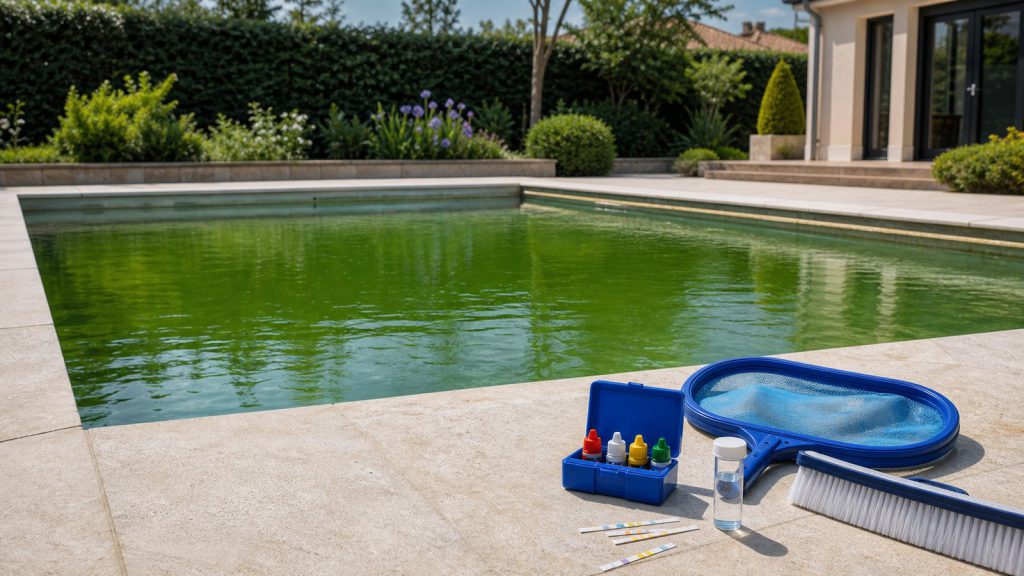
Quick answer: the most important habit is to regularly test pH, the disinfectant level and the state of the filtration. Clear-looking water on its own isn’t enough. Test a hot tub more often than a pool, because its smaller volume and higher temperature make mistakes worse faster.
This cheat sheet doesn’t replace the instructions from your chemical or equipment manufacturer. It’s meant as a guide to what to watch and why. Public pools and wellness facilities are subject to stricter rules than home pools.
Water values cheat sheet
| Parameter | Home pool | Home hot tub | Why it matters |
|---|---|---|---|
| pH | keep it within the range recommended by your chemical manufacturer, often around 7.2–7.6 | keep it within the manufacturer’s recommended range; warm water and jets shift pH faster | pH governs disinfection efficiency, eye and skin comfort, and scale formation |
| Free chlorine | home pools commonly work in ppm depending on the type of chemical and stabiliser used | the CDC states at least 3 ppm for hot tubs; Health Canada states 3–5 ppm for home spas | too little disinfectant is a hygiene risk, too much irritates |
| Bromine | an alternative to chlorine, depending on the system and the manufacturer’s instructions | the CDC states 4–8 ppm for hot tubs | bromine is a common choice for warmer water, but it still has to be tested |
| Total alkalinity | stabilises pH; address it whenever pH keeps swinging | critical for hot tubs, because pH shifts faster there | without the right total alkalinity, you’ll keep correcting pH over and over |
| Water hardness | important because of scale and cloudiness | important for the heater, jets and foam | hard water fouls the equipment; water that’s too soft can encourage foaming and corrosion |
| Temperature | higher temperature uses up disinfectant faster | the CDC recommends no more than 40 °C | warm water is pleasant, but it raises the hygiene demands |
| Water clarity | you must be able to see the bottom and the pool’s main features | the water shouldn’t smell, foam or feel slimy | clarity alone isn’t proof of safety, but cloudiness is a warning sign |
How to go about testing
- First check the clarity, odour, foam, slime and whether the filtration is running.
- Test pH and the disinfectant level before swimming.
- If pH keeps swinging, address the total alkalinity, not just pH products.
- After treating the water, let it circulate and mix, then test again.
- Don’t swim if there’s an odour, cloudiness, slime, unknown values, or after a shock dose that hasn’t been checked.
Useful related guides
- Safe water values for a pool and hot tub
- Total alkalinity in a hot tub and pool
- High pH in a pool
- How to test correctly with test strips
- Water diagnostics by symptom