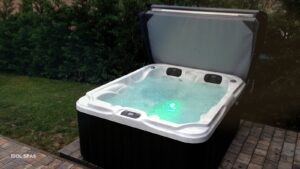
Canadian manufacturer Gecko Alliance supplies the control systems for a large share of European hot tubs. You can recognise them by a control box labelled in.xe, in.ye, in.yt or in.xm and by control panels from the in.k or in.touch series. When the system runs into a problem, it shows a code on the panel and usually shuts down the heater or the whole tub. Here is an overview of the most common ones.
Before you start: the meaning of the codes can vary by model and software version, so always check it in your hot tub’s manual. Before opening the equipment bay, switch the hot tub off at the circuit breaker.
Water flow: FLO and FLC
Gecko monitors water flow through the heater with a pressure or flow switch. If the switch doesn’t report what the system expects, the heater won’t turn on.
- FLO — the system has not detected water flow through the heater even though the pump is running. The heater stays off.
- FLC — the flow switch reports closed even though the pump is not running. In other words, the switch is most likely stuck in the closed position.
What to check for FLO:
- Water level — above the skimmer and the suction fittings.
- Filter — remove it and try running without it. If the code disappears, replace or clean the filter.
- Valves and suction covers — open and unobstructed.
- Air in the pump after filling — loosen the union nut on the outlet, bleed the air, tighten again.
- Whether the pump is actually turning — a hum with no flow points to a seized motor or a faulty capacitor.
With FLC, the cause is usually a faulty or fouled flow switch, or moisture in its connector. Replacing the switch is a simple job, but it must be done with the power off.
Overheating: OH, HL and AOH
- OH — the water in the hot tub is too hot (roughly above 42–44 °C, depending on the model). The system stops the heater and the pumps.
- HL — the high-limit safety cut-out has tripped: the temperature right at the heating element has reached around 48 °C. The system switches the heater off, and a reset by switching off the breaker is usually required.
- AOH — the space inside the control box is overheating (ambient overheat). Typically in summer, with the tub in direct sun, the equipment bay ventilation covered or long filtration cycles.
What to do: remove the thermal cover, let the water cool down, shorten the filtration cycles and check the flow just as you would for FLO — slow-moving water in the heater is the most common cause of HL. For AOH, clear the ventilation of the equipment bay and shade the tub. If HL appears at normal water temperature, a sensor or the heater relay is the likely suspect — that is a job for a technician.
Sensors and electronics: Prr, HR, UPL
- Prr — a problem with the regulation temperature probe (faulty or disconnected sensor). The heater won’t turn on.
- HR — an internal hardware error in the control unit. Try a reset at the breaker; if the error persists, the board needs to be diagnosed.
- UPL — the unit has no configuration (low-level settings). It usually appears after a board replacement or a software error, and is resolved by a technician uploading the configuration or by replacing the memory key.
With Prr, check the sensor connector on the board first — green corrosion or a loose pin is more common than a failed sensor.
Why you can’t “just buy a Gecko part”
Gecko has produced several generations of systems, and their parts are not freely interchangeable. The in.k200 control panel doesn’t fit every control box, boards differ by number of pumps, heater output and power supply, and sensors come in different lengths and with different connectors. When ordering, you will always need:
- The control box type from the label (for example in.xe-MP-CE or in.yt-7).
- The part number of the component being replaced.
- The number and type of devices connected to the unit — pumps, blower, ozonator, light.
With these details you can find spare parts for Gecko and Balboa control systems from specialist retailers, or have a technician identify the right replacement for you. Without them, you risk buying a part that may “fit Gecko” but not your particular unit.
When to call a technician
- The code keeps coming back even after checking the water, filter, valves and bleeding the air.
- HR or UPL persist after a reset.
- The hot tub trips the RCD, or you see discoloured connectors or moisture in the control box.
Any owner can check the water, filter, valves and air. Leave measurements and the replacement of sensors, switches, relays or the board to a technician, though — the work involves 230 V right next to water.
Next step
Planning a similar pool, hot tub or wellness project?
Move from inspiration to the company directory, a clear request or a regular editorial selection.