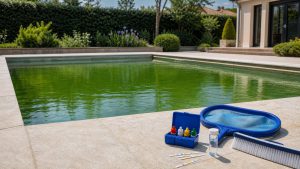
Short answer: Remove larvae mechanically, clean the filter, test pH and disinfectant, and disinfect based on the water’s condition.
Larvae in a pool are mostly a result of water standing for a long time, an uncovered pool, or weak disinfection. A net alone isn’t enough if the water is biologically active.
How to identify the cause
- Larvae near the surface or walls.
- The pool was uncovered for a long time.
- Low disinfectant level.
- Stagnant spots with weak circulation.
What to do now
- Remove the larvae with a net.
- Vacuum the bottom.
- Clean the skimmer and filter.
- Test pH and disinfectant level.
- Based on the test, shock-disinfect and filter.
When it’s better not to swim
- As long as larvae are swimming in the water.
- When the water is cloudy.
- When disinfection isn’t in order.
Prevention
- Cover the pool.
- Keep circulation running.
- Don’t let leaves and organic matter stay in the water.
- Test disinfectant levels regularly.
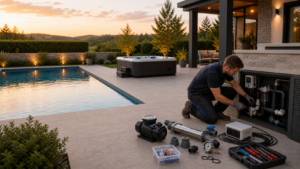
When to call a service technician
Call a service technician if larvae keep coming back even with correct disinfection and filtration, or if there are sources of standing water nearby.
FAQ
Do larvae prove the chlorine isn’t working?
They often point to weak disinfection or standing water, but testing is what decides.
Does covering the pool alone help?
Covering helps with prevention, but the current water still needs to be cleaned and tested.
Sources
- CDC – water testing in home pools and hot tubs
- CDC – hot tub safety
- Modrá střecha – pool discussion forum (Czech)
- Reddit r/hottub – common questions from hot tub owners
- Trouble Free Pool – community pool water advice
- ALBIXON – most common pool water problems
- ARIVA – green pool water
- Upravvodu.cz – pool water problems
- Laboratoř Monitoring – hot tub water treatment
Next step
Planning a similar pool, hot tub or wellness project?
Move from inspiration to the company directory, a clear request or a regular editorial selection.