Quick answer: if you have been using chlorine tablets for a long time and the water keeps going bad even though “chlorine shows fine” on a test, measure the stabiliser, CYA. CYA protects chlorine in an outdoor pool from the sun, but as it builds up it changes what the water needs for disinfection. For hot tubs, the CDC recommends not using CYA or chlorine products containing CYA at all. When CYA is high, what often helps is a controlled partial water change, not another tablet.
This guide is for situations where the water turns green or milky, chlorine disappears quickly, shocking helps only briefly and the problem comes back. It is not a substitute for the chemical’s label or for a service provider, but a practical way to tell when to address pH and filtration, and when it is time to measure the stabiliser.
CYA and chlorine tablets checklist
| Area | Question | Risk | What to do |
|---|---|---|---|
| What kind of chlorine you use | is it slow-dissolving tablets, dichlor, trichlor or another stabilised chlorine? | some chlorine products add stabiliser CYA to the water with every dose | read the label, find out the type of chlorine, and note how long it has been used without a water change |
| Measuring CYA | besides pH and free chlorine, do you also measure the stabiliser CYA? | the water can look fine on a chlorine test, but at high CYA disinfection behaves differently | use a CYA test or have the water measured with a reliable tester, and do not guess from the water’s colour |
| Free chlorine and pH | is the pH in a reasonable range, and does the free chlorine match the stabiliser being used? | poor pH combined with high CYA makes chlorine less effective and leads to recurring green or cloudy water | first correct the pH according to the label, then deal with chlorine and CYA together |
| Symptoms in the water | does the water go green, milky, or smell, or does the problem return even after shocking? | more tablets can mask the problem and keep raising the stabiliser | clean the filter, remove organic matter, measure CYA, and for a high reading plan a partial water change |
| Partial water change | is CYA high and the water hard to stabilise? | CYA is not reduced by normal filtration or a single shock dose | calculate a safe partial water change and take into account the sewer connection, groundwater, the liner and the pool’s construction |
| Hot tub | are you using pool tablets or stabilised chlorine in a hot tub? | the CDC recommends not using CYA or chlorine products containing CYA in hot tubs; a small volume and warm water react quickly | check the hot tub and chemical manuals, change the water if in doubt, and set the routine recommended by the manufacturer |
| Saltwater pool | is the pool fitted with a salt chlorinator, but chlorine still disappears or the water keeps going bad? | even a salt chlorinator needs the correct pH, filtration, stabiliser level and a clean cell; too much or too little CYA can make managing the water harder | check the CYA, salt, pH, filtration time, chlorinator output and the condition of the cell according to the manual |
| When to call for service | do you not know how much water to change, is the pool a public one, does the water keep turning green, or are the readings out of range? | a poor combination of chemicals, high CYA, weak filtration and biofilm can end up costing more than expert diagnosis | prepare the type of chemicals, a photo of the labels, pH/chlorine/CYA readings, the water volume and a history of what has been done |
Step-by-step procedure
- Photograph the labels of the chemicals you use: tablets, granules, shock, multifunctional products.
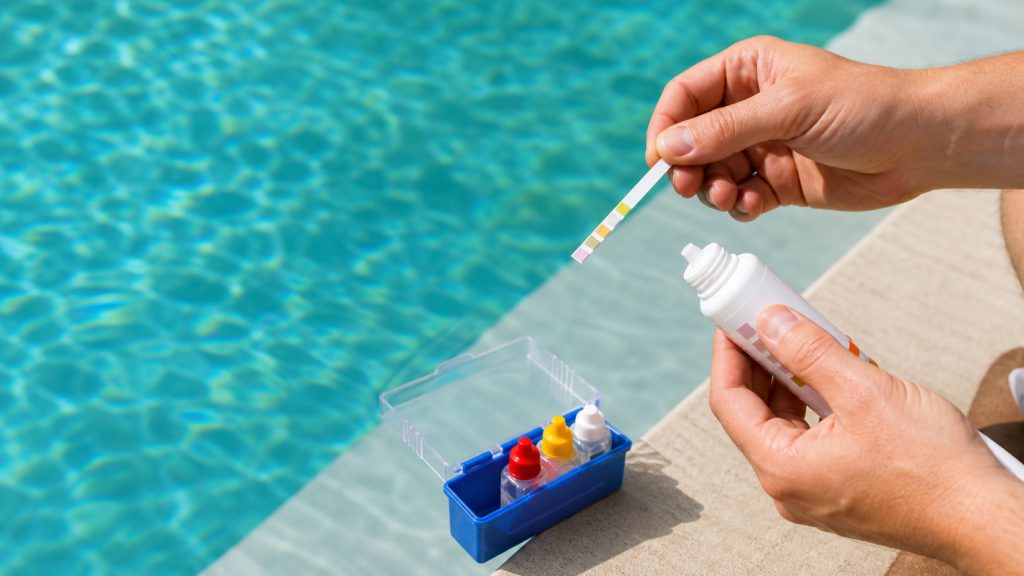
- Measure pH, free chlorine, combined chlorine if possible, and the stabiliser CYA.
- If you are not sure whether your test measures CYA, check the tester’s instructions or take a sample to a pool supply shop.
- First bring the pH into the range recommended by the label and the equipment.
- For high CYA, do not add more stabilised chlorine as the main fix.
- To lower CYA, calculate a partial water change and consider the risks of draining the pool.
- After topping up the water, measure pH, alkalinity, chlorine and CYA again.
- For a hot tub, follow the manufacturer’s manual, and if you suspect CYA or biofilm, it is better to restart the water.
Common mistakes
- Adding more tablets when the problem is actually caused by a build-up of stabiliser.
- Treating green water with shock alone, without measuring CYA, pH and the filtration.
- Using pool tablets in a hot tub without checking whether that is appropriate.
- Draining an entire built-in pool at once without considering groundwater and the structure.
- Comparing recommendations for a home pool with rules for a public facility without the context.
Where to go next
- A short explanation of the CYA stabiliser
- Partial water change calculator
- Saltwater pool and salt chlorinator
- Green pool water
- Water values cheat sheet
- Restarting a hot tub after a shutdown or biofilm
- Service brief for a water problem
Sources and background
This is based on CDC recommendations for home pools and hot tubs: when using CYA or chlorine products containing CYA, the CDC states a higher minimum free chlorine level for pools, and also recommends not using CYA or chlorine products containing CYA in hot tubs at all. We also draw on an overview of the current edition of the Model Aquatic Health Code and on pool industry practice showing that CYA is not reduced by normal filtration the way mechanical debris is.