Quick answer: if your pool filters poorly, the water goes bad quickly, the jets blow bubbles, or the flow is weak, start with the baskets, the pump basket, the water level, the valves, the filter pressure and the actual filtration time. Only then move on to chemicals, heating or automation.
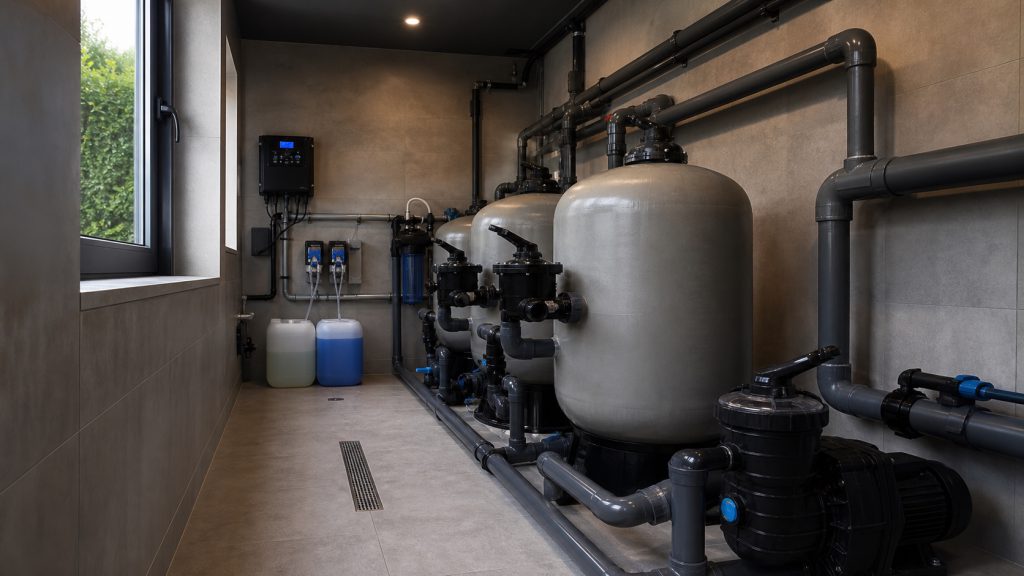
Filtration isn’t just “something that runs in the plant room”. It’s the foundation of circulation, mixing in the disinfectant, catching debris, and the performance of the salt chlorinator, heat pump and dosing system. So a weak flow often looks like a water problem, but it actually starts mechanically.
Checklist for pool filtration and the pump
| Area | What to check | Why |
|---|---|---|
| Weak flow | clean the skimmer basket, the pump basket, the cartridge or the sand filter, and check the valves and the water level | low flow reduces filtration, chemical mixing, heating performance and the automatic dosing system |
| Air in the system | watch for bubbles at the jets, the pump lid, the seals, the suction fittings, the water level and air being drawn in through the skimmer | drawing in air can cause noise, pump dropouts, poor pressure and uneven flow |
| Filter pressure | compare the current pressure with the clean starting pressure, and backwash the sand or clean the cartridge according to the instructions | rising pressure usually means clogged media; a very low pressure can point to a suction problem or a weak flow |
| Filtration time | work it out from the water volume, the actual flow rate, temperature, bathing load, weather and the required number of turnovers | a fixed rule like eight hours a day will not necessarily suit a small pool, a large pool, hot weather or a hot tub |
| Pump speed | on a multi-speed or variable-speed pump, keep a low setting for filtration separate from a higher setting for cleaning, the counter-current or vacuuming | a lower speed can save energy, but it must still keep enough flow for filtration, heating and dosing |
| Connected equipment | check the minimum flow required for the heat pump, salt chlorinator, UV lamp, dosing system and flow switches | many heating, chlorine or dosing faults are actually a circulation problem |
| When to call a service technician | call a professional if the pump runs dry, there is a burning smell, the breaker trips, there is a leak, noisy bearings, a cracked lid, or repeated air-locking | the electrics, shaft seal, pump and pressure vessels are not a safe place for guesswork without the right knowledge |
What the symptoms usually mean
- Bubbles at the jets: often a low water level, air being drawn in at the suction side, a leaking pump lid, or a valve that isn’t fully closed.
- Weak suction at the skimmer: a clogged basket, a blocked pump basket, a closed valve, a dirty filter, or air in the pump.
- High filter pressure: dirty sand, a dirty cartridge or clogged media, or a restriction downstream of the filter.
- Low filter pressure: a suction-side problem, a low water level, an airlock, blocked suction, or a pump that isn’t delivering enough performance.
- Green water despite the chemicals: not enough filtration run time, weak flow, poor testing, the wrong pH, or a heavy load on the water.
How many hours to filter
A rough plan should be based on the water volume and the actual flow rate, not just the output printed on the label. In hot weather, after a storm, after a big gathering, with green water, or with a hot tub, the routine needs to be stricter. If the pump has several speeds, it is often useful to filter for longer at a lower flow and briefly switch to a higher setting for mixing, cleaning or vacuuming.
Where to go next
- Pool and hot tub filtration runtime calculator
- Water diagnostics by symptom
- Green pool water
- Heat pump and flow
- Automatic dosing and flow
- When to call a service technician
Sources and background
For general principles, this draws on Energy.gov guidance on efficient pool pump operation and CDC guidance on the importance of proper circulation, filtration, pH and disinfection. Always check the specific pressure, flow rate, backwashing, intervals and safety information in the filter and pump manual.