Quick answer: a salt pool is not a maintenance-free pool. The salt chlorinator produces chlorine from salt, but you still need to test pH, free chlorine, salt, stabiliser and filtration, and check the condition of the cell. For a “low salt” or “high salt” error, first confirm the reading with an independent test and the manufacturer’s instructions.
The most common mistake with salt pools is thinking that salt replaces monitoring the water. In reality, it just changes the way the disinfectant is dosed. If the pH is wrong, filtration is too short, the cell is fouled, or there isn’t enough stabiliser, the water can deteriorate just as it would in a classic chlorine pool.
The most common situations with a salt pool
| Situation | What to check | Next step |
|---|---|---|
| The salt chlorinator reports low salt | confirm the reading with an independent salt test, check the manufacturer’s instructions, the water temperature and the flow through the cell | add salt gradually according to the water volume, and retest only once it has dissolved |
| The salt chlorinator reports too much salt | test to check it isn’t a probe/cell fault; check whether salt was accidentally added twice | usually only a partial water change helps, based on the actual reading and the unit’s instructions |
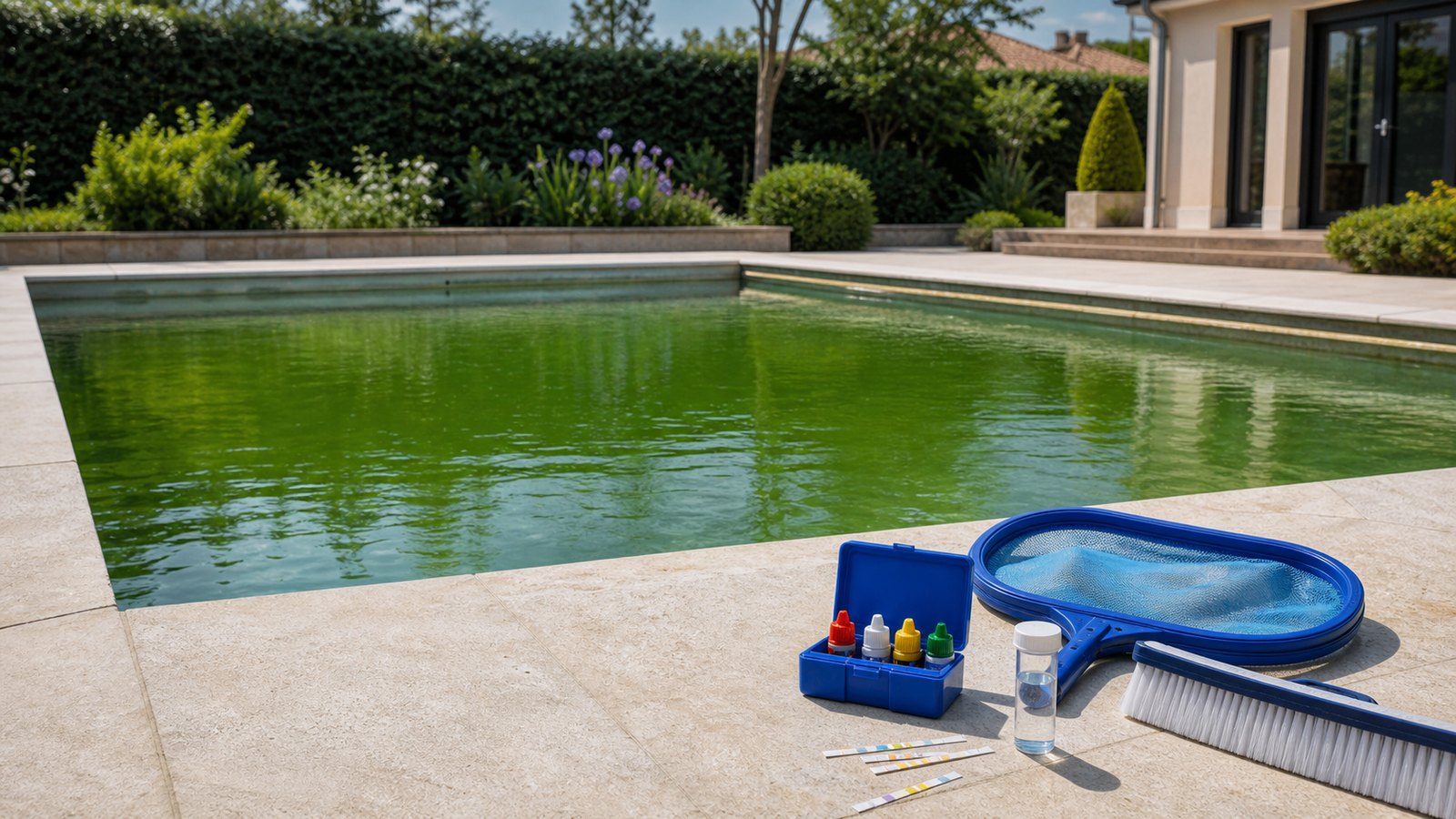
| The water is green even in a salt pool | test free chlorine, pH, stabiliser level, filtration time, the chlorinator’s output and how clean the filter is | a salt pool still needs enough disinfectant; the salt chlorinator is not a substitute for testing |
| The cell is fouled with scale | switch off the power, inspect the cell visually, and follow the manufacturer’s exact procedure | clean it only as described in the manual; unnecessary acid cleaning shortens the cell’s lifespan |
| The salt chlorinator is producing too little chlorine | check the output setting, daily run time, flow, water temperature, cell age, pH and stabiliser | in season you may need longer filtration or a higher output, but the water readings need to be right first |
| Nothing changed after adding salt | wait for it to dissolve and mix in, keep the filtration running, and don’t test right at the spot where you added it | adding salt repeatedly without letting it mix in easily leads to over-salting |
| Corrosion stains or damage nearby | check the salt concentration, water leaks, the materials around the pool, earthing/bonding, and regular rinsing | for metal fixtures and expensive surfaces, it’s sensible to bring in a service technician or equipment supplier |
What to check regularly
- pH and free chlorine, according to the recommendation for your pool and product.
- The salt level, according to your specific salt chlorinator’s manual.
- Flow through the cell, how clean the filter is, and the filtration run time.
- Scale on the cell and any error messages from the control unit.
- Stabiliser level for an outdoor pool, but without using generic doses without testing.
What to avoid
- Don’t top up salt just because of a warning light, without an independent test.
- Don’t acid-clean the cell more often than the manufacturer recommends.
- Don’t let the salt chlorinator run with weak flow or air-locked equipment.
- Don’t expect the salt chlorinator alone to fix green water, the wrong pH, or a clogged filter.
Where to go next
- Salt pool calculator
- How to test the water correctly
- Water values cheat sheet
- Filtration calculator
- Green pool water
- When to call a service technician
Sources and background
For basic disinfection and pH, follow CDC Healthy Swimming. For the salt chlorinator, the specific manufacturer’s manual is what matters, since the salt range, error messages, cell cleaning and lifespan vary from unit to unit.